By Tara V. Kohlenberg —
The Guadalupe River is always there. It is life-sustaining water. It rages. It slows to a trickle. It calls us to fish, to play, or to watch sunlight dance off its surface as it rolls on toward the coast. The river beckons us to gather at its edge to make extraordinary memories while enjoying the ordinary.
River Road follows alongside the Guadalupe River for approximately 10 miles from just outside New Braunfels up to Sattler. Just getting to places on the Guadalupe River by way of River Road is half the fun. Sometimes driving River Road IS the fun.
The River Road area has a long history, much of which took place before humans inhabited it. This region once was covered by a vast sea, depositing layers of silt for millions of years. Then, sometime 5 to 66 million years ago, the earth’s layers shifted up, down and sideways, creating what we know here in Central Texas as the Balcones Escarpment.
If you look at a map, the escarpment is that funny ridge of hills in the middle of Texas dividing the Hill Country from flat Blackland Prairie. It curves up from Del Rio to San Antonio and north of Waco. You might also recognize that curve being the same as the cold front and storm warning lines on the local weather channels. Ever wonder why bad weather seems to hang over I-35? Perhaps, because I-35 is built on the Blackland Prairie along the Balcones Escarpment? But, I digress. All that was to point out that Comal County sits on the edge of the Balcones Escarpment. The Guadalupe River cuts crossways through the escarpment to create postcard-perfect scenery of steep bluffs and towering cypress trees lining its banks.
Seeking larger tracts of land outside of New Braunfels, some immigrants moved out to the Hill Country. In the 1870s, Wilhelm Bretzke began acquiring land in the area between what is now FM 306 and the Guadalupe River. The Bretzke Ranch reached more than 1,700 acres. As more immigrants came, they pushed further out along the river, establishing the communities of Wallhalla and Sattler. Getting there could be difficult since early roads consisted of mostly cattle trails and rough wagon roads.
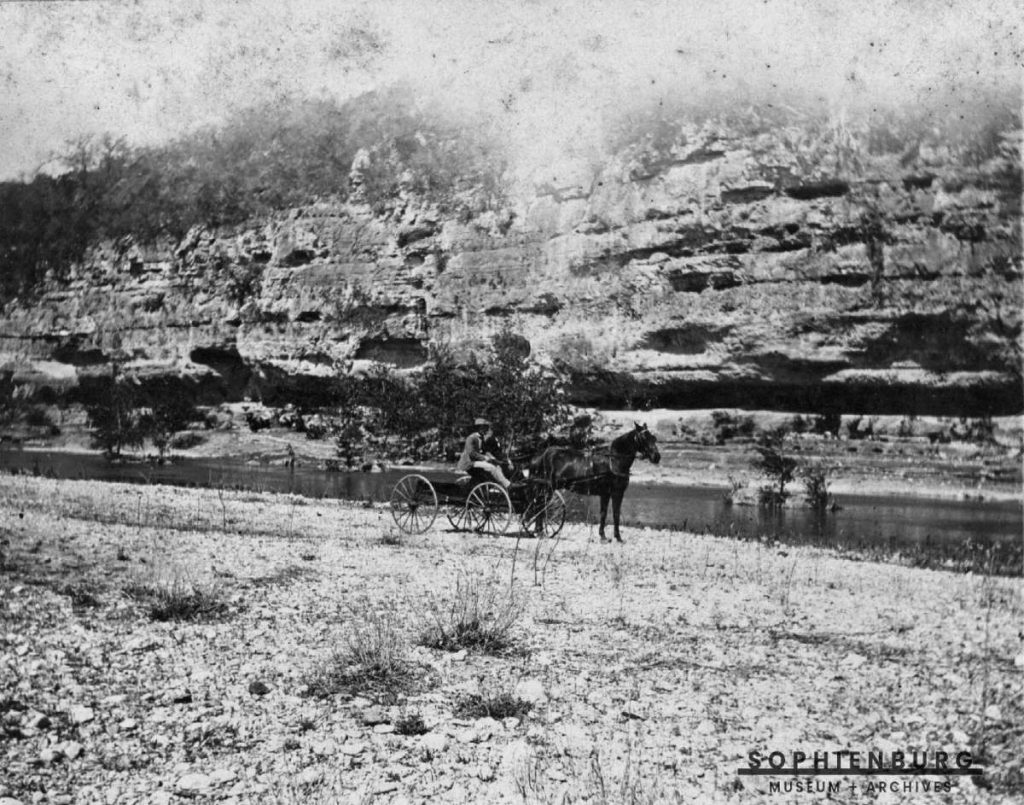
In 1901, Comal County Commissioners established a real road. Guadalupe River Drive (now River Road), was one of the earliest roads built in Comal County. The “public road, third class, twenty-two feet wide with gates” was basically a rock trail cut from the hillside used by farmers and ranchers traveling (think horse and buggy) to New Braunfels. It stretched nearly 10 miles from New Braunfels up the river toward Sattler.
A 1905 account of a social event at Wallhalla described the “romantic and beautiful bluffs and water scenery” as 75 people traveled River Road to their destination. It also emphasized caution on the “dangerous canyon” road in the dark after experiencing a broken hack wheel and broken buggy shaft along the way. That is a seriously rough road.
The road may have been established by the county, but there was no budget for maintenance. By 1918, landowners and townspeople were asked for contributions to repair River Road, to which many graciously contributed. In the ‘20s, as the automobile increased in popularity, property owners and civic groups petitioned the county to upgrade the road from third-class to second-class road.
Road building and improvements were helped along by the Federal Aid Road Act in 1921 and state gasoline tax in 1923. Even then, occasional high water still required “mountain people” to ride a horse the back way to town, as their vehicles could not make it over the flooded crossings. The Works Progress Administration (WPA) of the 30s funded 49 men to rebuild River Road. Through the program, Comal County’s portion was $12,242.46 and the federal portion was $15, 363.
The 1950s saw an increase in outdoor recreation. River Road was built out and paved all the way to Sattler. People would drive River Road on a bright, sunny day and picnic in the areas along the rivers. The Wilhelm Bretzke property included a lot of river frontage between first and second crossings, and the Bretzke family made use of it. They opened the river front property to campers and named it KL Picnic & Campgrounds. Surely, they had no idea what they had done for the camping business on River Road at the time.
Comal County Commissioners let a contract to build new bridges in 1964 to replace the low-water crossings, which flooded easily. Later in 1965, as the work progressed, there was huge uproar about the destruction of trees. A line of 40 mature cypress trees adjoining the K&L Ranch property, many of which were over 3 feet in diameter, were bulldozed to raise the roadbed up by 8 feet and prevent flooding. The pleas of the local residents and civic organizations to save the majestic trees were denied. An additional 30 cypress trees were cut to widen the channel at third crossing.
Picnic and camping grounds popped up everywhere along the river in the ‘60s and ‘70s, mostly due to the completion of Canyon Dam. Travel along River Road became treacherous. Cars could park on both sides of the narrow rural road, making it tough for two cars to pass each other while watching out for happy drunks and people standing in the roadway. As of July 1976, parking on River Road was no longer allowed.
The Guadalupe River is still there and so is River Road. The Bretzke family is still there and so is KL. I am a native of New Braunfels with many decades under my belt. I know the Bretzke family and I have been to KL Picnic & Campgrounds multiple times. Until recently, I did not know why Bretzke Ranch included “KL” in their business names. So, here it goes.
Back in the 1870s, Wilhelm Bretzke leased out acreage to one Mr. Louis Klappenbach to graze cattle. Mr. Klappenbach eventually sold all of his cattle to Wilhelm, as well as his cattle brand, KL. The Bretzke Ranch became known as KL Ranch because of the brand.
Wilhelm Bretzke’s son, Robert, had a son, R. Lee Bretzke, who began KL Picnic and Campgrounds. He passed the business to his sons, Mike and Dave Bretzke, who then changed the name to KL Ranch Camp. Today, the KL name is carried on by the next generation, operating as KL Ranch Camp — On the River, run by Tara Bretzke Hildebrand (Jason), and KL Ranch Camp — Cliffside, run by Bobby Bretzke (Jennifer).
Just like the river, River Road has changed over time. It is still a great scenic drive, especially in a convertible on a bright spring afternoon when the water is calm and the Texas and American flags ripple against a canopy of green. Have a great summer.
Sources: Sophienburg Museum and Archives; Handbook of Texas Online; Julie Bretzke.
“Around the Sophienburg” is published every other weekend in the New Braunfels Herald-Zeitung.