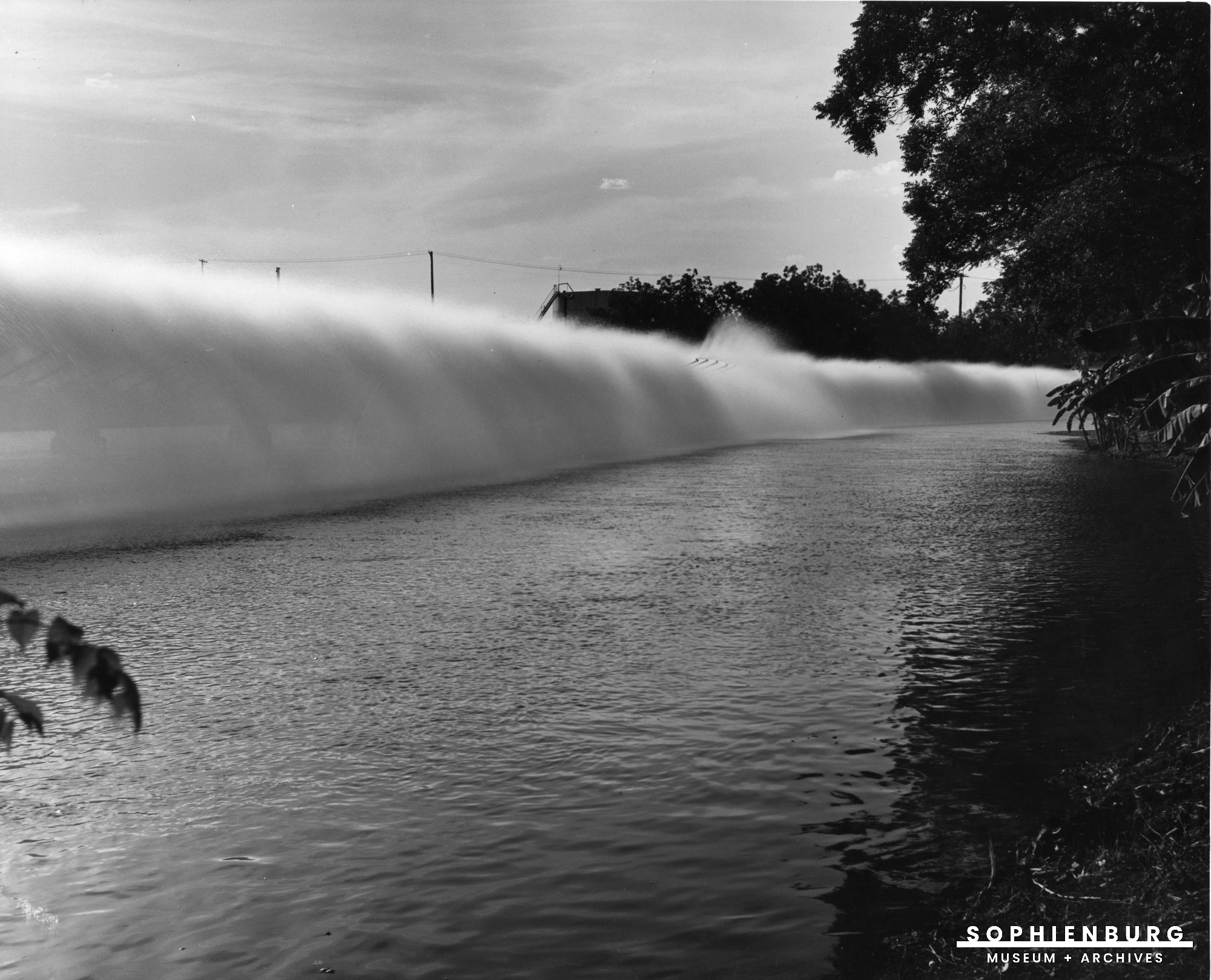
PHOTO CAPTION: Photo of LCRA Comal Power Plant spray heads over the millrace channel of the Comal River.
By Tara V. Kohlenberg —
For as long as I can remember, water has been a topic of discussion in New Braunfels. Too much. Too little. How we find it. How we use it. Water is, after all, one of the main reasons this little piece of heaven perched on the edge of the Balcones Escarpment was chosen by Prince Carl for his settlement. It had fresh water. Lots of it.
I cannot say anything about others that grew up in New Braunfels, but I have seen a few of the “too much, too little” cycles over the years and it has helped me to not only respect the power of the water, but to be mindful of how we use it. We lived it and were reminded daily. I even remember Herb Skoog announcing the morning aquifer report on KGNB, measurements taken by Oliver Haas at the Panther Canyon well.
New Braunfels and Central Texas have experienced a serious lack of rain over the past two years., with Comal County listed in the “exceptional drought” category. The drought has been visible in the rivers, stock tanks and lake levels. And yet, the most recent media reports of “too much” water and flooding on the Guadalupe will still not be enough to bring the aquifer back to the proper water levels.
There have been many drought years recorded in New Braunfels with high temperatures and little rain: 1918, 1934, 1949 through 1956, 1958, 1974 and more. There have also been many flood years: 1972, 1998 and 2000. I happened to be born in 1956, the only year that the Comal Springs went completely dry. It was also the year that they cut down last dead elm tree in the middle of Coll Street (where Hermann Seele taught the first immigrant children. Believe it or not, it was during the drought years that work began on plans for flood prevention and water conservation. The first discussions took place as early as 1929. After the springs dried up in 1956, things got moving in earnest.
The men involved in those discussions worked tirelessly to protect the Edwards Reservoir, which they determined to span 1,500 square miles and five counties: Kinney, Uvalde, Medina, Hays and Comal. To get the people across five counties, along with the Chambers of Commerce, taxing entities, Texas legislature and the Corp of Engineers to cooperate was a chore in and of itself. Although a number of men representing Comal County were involved in watching over our water, there are two who stand out. Paul Jahn and Oliver Haas were passionate about our water resources.
Born in 1893, Paul Jahn, grandson of famed furniture maker Johann Jahn, was instrumental in the creation of the Edwards Underground Water District in 1959. After the Comal Springs ceased to flow, Jahn wanted to make sure that it never happened again. He realized that the key was the aquifer, specifically the recharge zones that filled the aquifer which fed the springs. Jahn served as chairman of the EUWD for 13 years and then three six-year terms as director. His opinions were not always popular, but he led the district through 30 years of protecting the Edwards Reservoir.
The 15 EDUW district directors elected from the five counties were tasked with planning a well-organized water conservation and recharge program for the Edwards Underground Reservoir. One of the most important things that they accomplished was having a masterplan of the Edwards Reservoir district, identifying all recommended sites for flood control and recharge structures. In 1963, the initial studies released by engineers indicated that at the 1963 rate of water withdrawals, the rate of population increase and the rate of natural recharge to the reservoir, the Comal Springs would cease to flow and the Comal River would be a dry riverbed by 1970. Yikes! That was when the population of New Braunfels was only 15,000 people.
The second man is Oliver Haas, nephew of local historian Oscar Haas. Oliver was so passionate about water that he answered his phone, “Conserve water!”. Born in 1912, he endured many of the hardships of his generation. He graduated from high school in 1929 and headed off to Schreiner Institute in Kerrville. With the Crash of 1929 and Great Depression, he was forced to leave school after one year. Money was tight and so were jobs. Haas worked a variety of jobs before ending up at the Landa Park boathouse. At the boathouse, he worked the weedcutter. It was a flat-bottom boat equipped to cut the weeds growing in Landa Lake so that boats could still traverse the lake easily. Then, the cut weeds would float down the millrace and be captured by equipment before floating down the Comal River.
In 1933, Haas got a job with Comal Power Plant under the National Recovery Act. He began as a technician and worked his way up through operator, assistant chief engineer to plant superintendent. The Comal Power Plant, which came on line in 1926, was the largest power plant west of the Mississippi and the main generating station for the City of San Antonio. The plant ceased operation in 1973. Haas retired in 1974. Haas served as vice-chairman of the Edwards Underground Aquifer District.
The Comal Power Plant was a steam-electric plant. Everything in the power plant had to do with water. The plant was built to use water pulled from the millrace for cooling. The heated water would then be discharged through a tunnel to the Dry Comal Creek to return to the river.
Beginning in 1949, there were several exceptionally hot, dry years impacting the Comal Springs. Haas, as an engineer at the power plant, saw the critical importance of water during the drought of 1950s. Without water, there would be no power generated. As water flows declined, they installed a system of sprinkler spray heads along the millrace to recirculate the warm water. They were essentially pumping the sprayed water back up into the plant and using it a second time. Seeing the warmed water spraying over the millrace was really cool to watch! It looked like a Las Vegas water fountain feature with sunshine making rainbows above the river. However, spraying warm water created its own set of issues, including extreme humidity, fog, and complaints of warm water downstream. That prompted a cypress cooling tower to be built over the water. I still remember the clicking noises coming from the tower as the water trickled through it. Eventually a well was drilled on the Fredericksburg Road side of the power plant property to supplement their water needs. The cooling tower and spray head system were dismantled some years ago. You can still see the large cement blocks which supported the sprinkler pipes on the cement apron above the millrace.
It is people like Paul Jahn and Oliver Haas who not only reminded us that water is life, but they did something about it to protect water. The Comal Springs flow today is 141 cubic feet per second compared to the historical high average of 266 cfs. The Edwards Aquifer, now supports eight counties and 2.5 million people. Wow! What do you think Jahn and Haas would say? “Conserve water!”
Sources: Sophienburg Museum and Archives; Harvey Haas; Sandra Towery.