By Keva Hoffmann Boardman —
Divining. Dowsing. Witching. Switching.
These strange words all refer to the same thing, an ancient method of finding something under the ground. It’s not science. It’s not magic. Some people have “the gift” and others do not. In many cases, the ability is found generationally in families. Whatever it is, it has proven to be a relatively effective technique for finding minerals, coal, oil, water, treasure and burial sites for centuries.
German miners used dowsing rods to locate minerals in the 1400s. English miners were using the method in the 1600s. Americans tended to call dowsing either “witching” or “switching”, possibly because many practitioners used witch hazel branches (switches) for the rods. Dowsing rods can be made of hazel, hawthorn, willow, peach, pear or cherry branches, but not elder. Elder trees were associated with witchcraft and dowsing is not witchcraft.
Dowsing rods are simple to use. The diviner (dowser, witcher or switcher) holds the ends of a Y-shaped branch with the joint nosing upward and then walks across the ground they want to survey. Say he or she is looking for water — when underground water is passed over, the joint end will point down or twist. The strength of the rod’s movement can even estimate the distance under the surface so you know how deep to drill for a well.
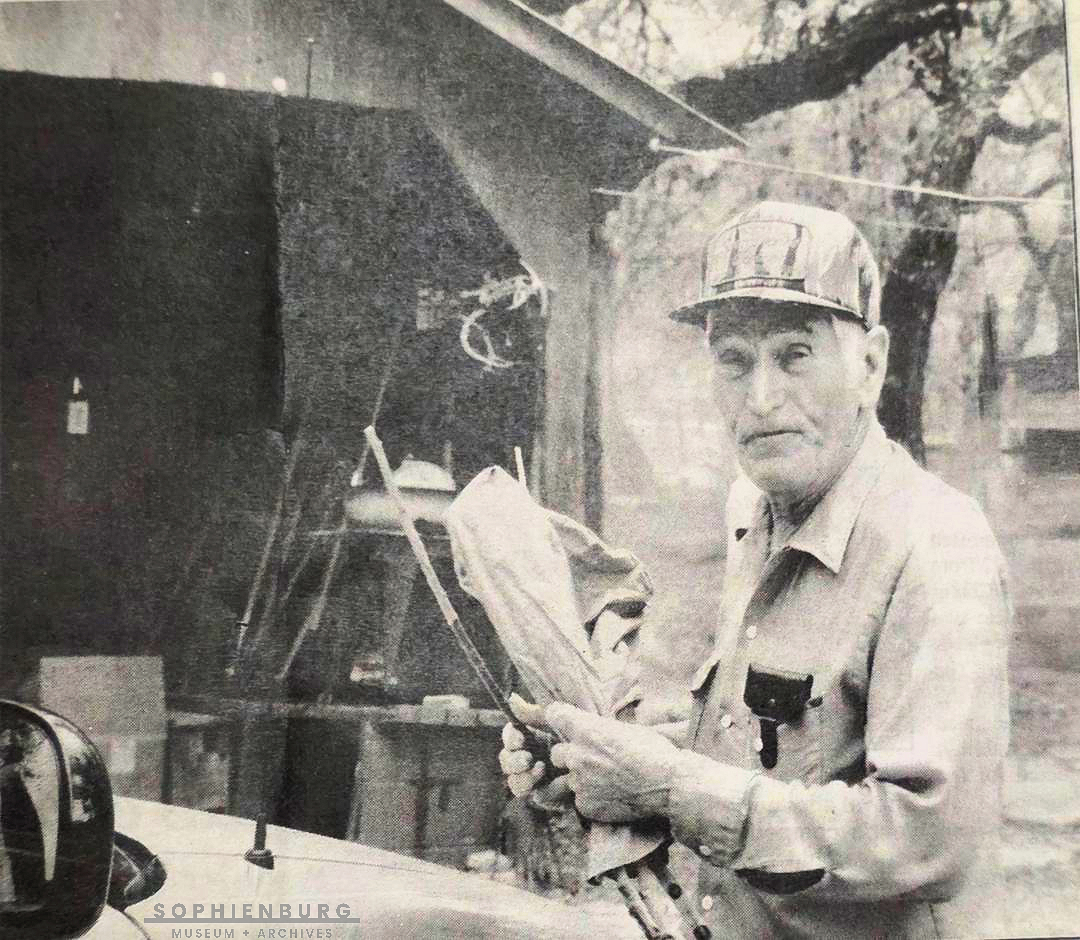
Elmo Jonas (1916-2001) learned how to switch for water in the 1930s from watching his uncle. As a Wassersucher, or switcher, Elmo used a Y-shaped rod from the branch of a peach tree. He stored his rods wrapped up in his freezer. Mr. Jonas was known across the county for his ability to find water to help people locate sites for wells on their property. In a New Braunfels Herald-Zeitung article, Mo Schwab was quoted saying, “To my knowledge, he’s never had a client say it was a dry hole …. He doesn’t charge for switching. He earns his living on his sheep ranch off Purgatory Road. People make donations if they want to, but I know he’s found good water sources for people who gave him nothing.”
In other words, he wasn’t scamming anyone.
The Herald-Zeitung interviewed Elmo in 1995 about the “gift” he shared with others. He and many of his neighbors were relocated when their family ranches and farms were bought to make way for Canyon Lake and Dam in the late 1950s. Buying new land and building a new home made it necessary to also drill new wells. Elmo Jonas found just the right spot for good wells for those resettling.
How does it work? No one really knows. Some think it has to do with a physical principle, possibly electrical in nature, that isn’t yet understood. Curtis Bremer (1934-2016) said, “There is no scientific evidence, but I’m satisfied that it works, and I’ve used Elmo Jonas on six or eight wells. I’d want a switcher if I were drilling a water well today because you increase your probability.”
The U.S. Geological Survey can’t prove how or if it works so they caution against using a water witcher. But, they cannot prove it doesn’t work, and as many people have seen, somehow it does. In 1975, Mrs. James Mayer of Bulverde was asked to locate water for a well at the Comal Indepent School District’s Smithson Valley High School. Successful, she was asked by the school board to also find water for Mountain Valley Elementary and Middle School in Sattler. Harvey Pape reported on that experience. “She would just walk across the field and the rod would go straight down — she just could not hold it. There were two places on our land like that. It was really amazing to watch, in fact, the first switch she used split in half.… She gave me the switch, and it wouldn’t do anything, … we gave it to my little daughter, and the switch pulled almost out of her hands.”
Water is not the only thing people switch for. Former educator Wilfred Schlather also uses a divining rod to locate lost gravesites. Sounds weird, right? Mr. Schlather taught high level math and physics at New Braunfels High School as well as hand-built the first computer on campus. He is definitely no stranger to scientific facts. He doesn’t know how switching works, he just knows that it does.
I got to go on a grave hunt with Wilfred (It is so hard not to call him Mr. Schlather.) a couple of years ago. We needed to find out where a young boy was buried in one of the local cemeteries. We vaguely knew about where he was lying, but with no headstone, it was just guesswork. Wilfred got out his switching rods — two copper pipe cylinders in which he put L-shaped pieces of wire. He held one copper cylinder in each fist so that the long end of the L-shaped wires swung freely facing forward. As he passed over different areas of ground, we watched in astonishment as suddenly the wires turned inward and crossed each other and then several steps later uncrossed. I. Kid. You. Not.
Wilfred repeated the action flagging where the wires first crossed and then flagging where they uncrossed. Between the flags was the exact space that would be needed to bury a child’s casket. To make certain of his results, he walked parallel to the marked space. The wires did not cross. When he walked across the area of another marked grave, the wires did their crossing thing again.
“May I have a go, Wilfred?” I asked hesitantly. “Here, try it,” he said, handing me his rods. I held one copper pipe in each fist and with the rods floating forward walked over a marked grave. At the foot, the wires turned inward and crossed. At the headstone, the wires uncrossed. I tried the burial site he had just located. At one end of the space the wires turned inward and crossed and at the other end the wires uncrossed.
It was quite the OMG moment. Apparently, I have the “gift” for finding graves. Who knew I was so blessed. I was telling my mom about this article. It seems I had an uncle in the Fredericksburg area who was a water switcher. Looks like I need to try switching for water!
Sources: New Braunfels Herald; New Braunfels Herald Zeitung; Texas Escapes Online Magazine: “The Ancient Art of Dowsing”, “Dowsing for Graves, Witching For Water”; Farm and Dairy, “The Curious History of Water Witchers”.
“Around the Sophienburg” is published every other weekend in the New Braunfels Herald-Zeitung.