By Tara V. Kohlenberg —
When I was 6 years old, I remember proudly being able to finally count to 100 without messing up. I counted 100 pennies. I counted 100 M&M’s (though I rarely made it through that without eating some). Those were tangible. It is still very hard for me to wrap my head around counting 100 of anything intangible … like 100 years. What was it even like 100 years ago in 1926?
Well, World War I ended in 1918. The U.S. economy was humming along, and automobiles became common place. Queen Elizabeth II was born, and the magician Houdini died. The famed U.S. Route 66 was established, connecting Chicago, Illinois to Santa Monica, California. Closer to home, the towering Comal Power Plant (LCRA, now The Landmark Apartments) was built, and, believe it or not, the Women’s Civic Improvement Club funded the installation of a women’s restroom under the bandstand on Main Plaza.
As New Braunfels grew, the number of churches grew to serve the needs of people moving into the community. In August of 1925, an announcement appeared in the New Braunfels Herald touting Rev. H. Schliesser, a field missionary of the Lutheran Texas Synod, was in New Braunfels to organize a Lutheran congregation. The first services, conducted in German, were upstairs at Mergele Hall.
The Mergeles of Harry Mergele’s Hall are founding families from France. They were merchants. Their home is the little green building that sits behind the store at 166 Comal Avenue (now the chiropractor office). Mergele Hall may not ring a bell with you because the building has had so many other occupants. The two-story building, now the home of Water 2 Wine at 185 S. Seguin, has housed many entities over the years, including a place for the militia to drill, a dance studio, piano studio, and an assembly hall, part of Denson-Dedeke Gifts (downstairs) in the ‘80s and the original retail space for Celebrations Bridal (upstairs). St. Paul Lutheran was one of many churches that got their start upstairs at Mergele Hall.
The new Evangelical Lutheran St. Paul Congregation was established and officially recognized March 21, 1926. The church continued to grow under the guidance of the Rev. H Schliesser. The services were conducted in German in the morning and English in the afternoon with Sunday School in between.
By October 1926, the Lutheran Mission Board of the Iowa Synod voted to contribute to the St. Paul congregation, helping them purchase a house and lot on San Antonio Street for a parsonage, along with two adjacent lots to build a church on Santa Clara. They operated out of those few buildings for a while as they continued to grow their services.
Within a year, they added a St Paul Lutheran Ladies Aid and St. Paul Luther League (for teens), and the St. Paul Lutheran Brotherhood. 1928 saw more opportunities to participate in worship with the creation of the sanctuary and junior choirs. Then, the Great Depression hit.
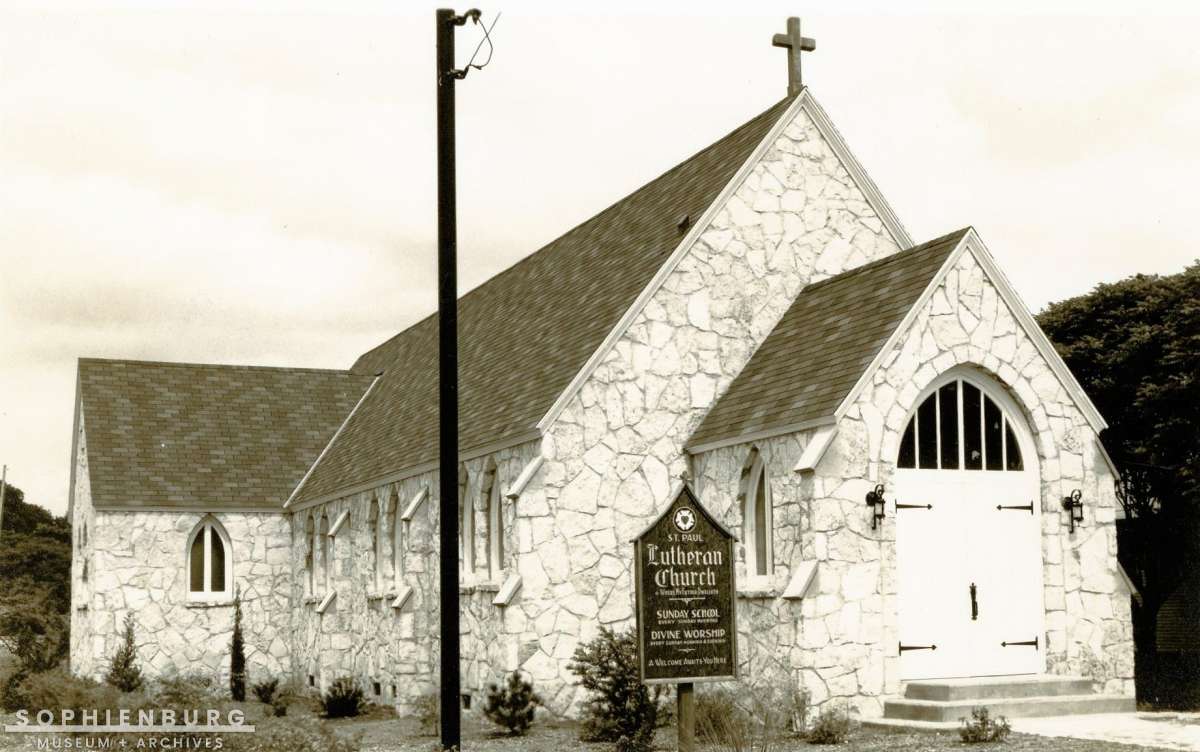
In 1939, Rev. H.A. Heineke formed a building committee to begin planning a new church building. The church, designed by noted architect, Jeremiah Schmidt, and built by C. R. Roessler, was built of native fieldstone with beautiful dark wood interior beams/trim and stained-glass windows. The $6,000 ($110,000 today) note covered the building and furniture. The church, now known as the Chapel, was dedicated on April 14, 1940. The Chapel is one of the only Jeremiah Schmidt buildings in New Braunfels without a Texas State Historical marker.
St. Paul’s congregation continued to grow, much like churches across the U.S. in the 1960s. This growth prompted the congregation to expand their footprint. In 1962, a new, larger sanctuary was built. The new church building wrapped around the original Jeremiah Schmidt chapel, with its modern design incorporating similar stone, wood beams and colorful stained-glass windows.
With New Braunfels being 180 years old, you might wonder why it took 80 years for a Lutheran church congregation to be established. Well, there is a whole backstory to that. The Lutheran denominations began in Europe and arrived in Texas with German, Swedish, Czech immigrants. In 1850, Pastor Kleiss of Baden, Germany, arrived in Texas to check out the possibilities for new Lutheran congregations. He established himself in the Hortontown and Neighborsville communities across the river from New Braunfels.
In 1851, the German-speaking congregation erected St. Martin Church, the oldest Lutheran church in Texas. A school building was built in 1870 (still standing across from New Braunfels Conservation Society gate). The congregation grew until the turn of the century. St. Martin’s was part of the Evangelical Lutheran Synod of Texas. It became difficult to supply churches with German-speaking pastors who were of Evangelical or Reformed faith. When services were discontinued, the congregants attended nearby German-speaking churches, First Protestant Church in New Braunfels or Friedens Church in Geronimo.
St. Martin’s Church was taken over and restored by the St. Paul Lutheran Congregation in 1963. St. Martin’s Church was moved to its present place in the Hortontown Cemetery when Loop 337 was built and is marked by a Texas Historical Marker. St. Paul Lutheran Church still holds special services in St. Martins.
One hundred years ago, St. Paul Lutheran began a journey in Christ and extended itself to not only take care of future congregants, but to honor the history of Lutheranism in Texas. Here’s to counting 100 more years!
Sources: Sophienburg Museum and Archives
“Around the Sophienburg” is published every other weekend in the New Braunfels Herald-Zeitung.