I really haven’t lived through a major war, but my mom and dad did. I have heard their stories and they are very different because Mom lived on a ranch/farm north of Fredericksburg and Dad lived in New Braunfels. Myra Lee Adams Goff grew up with my dad and she described those times through the eyes of the child she was then. In light of the current world situation, I thought it would be good to reprise Myra Lee’s article and see how New Braunfels coped back then with the uncertainty and fear that such times engender. — Keva Hoffmann Boardman
Around the Sophienburg, December 27, 2006
By Myra Lee Adams Goff —
It’s the end of December and this pesky little song has entered my head again and won’t leave. “Let’s remember Pearl Harbor as we did the Alamo.” I’m back in Julia Odiorne’s fourth-grade class at Lamar School. Earlier, on December 7, 1941, a surprise attack on the U.S. fleet at Pearl Harbor had suddenly plummeted our country into World War II. We sang this song with gusto because as Texans we would never forget the Alamo and now we would be called on to “Remember Pearl Harbor” forever.
Miss Odiorne tacked a map of the world on the wall that she had gotten from the Weekly Reader, a newspaper for children. Every time Germany won a battle, she would place a little swastika on the map and for Japan it was a little white flag with a red “rising sun” in the middle. Naturally when the U.S. won, there were stars and stripes. For all that first year, there were almost nothing but swastikas and red suns, and that was scary.
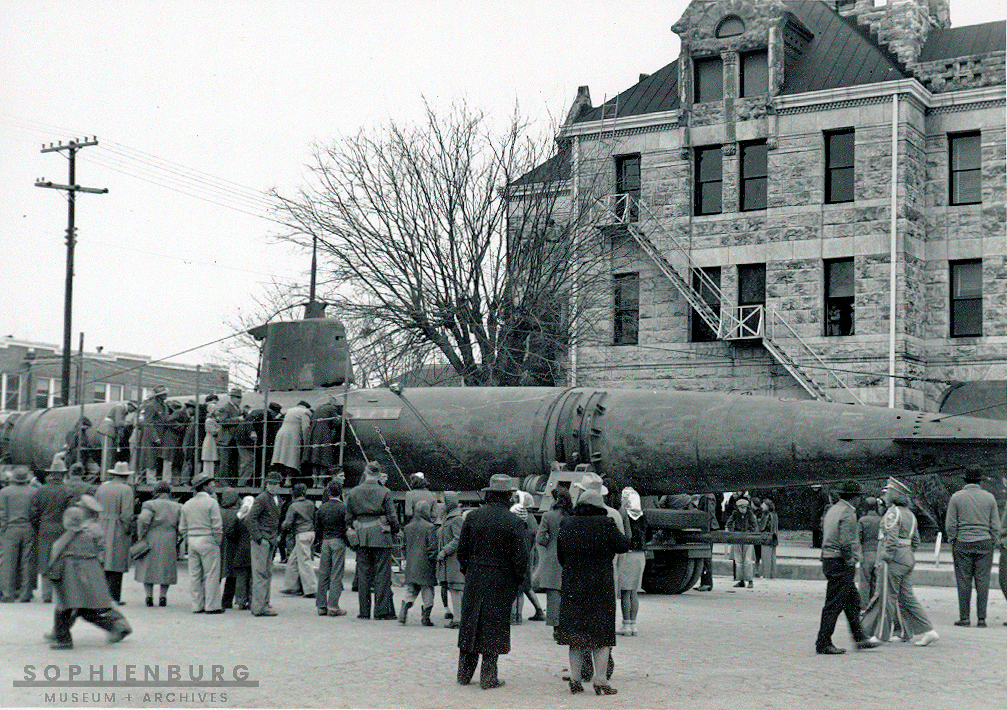
We kept on singing and doing our part as children. The Junior Texas Rangers, as the children were called, collected scrap metal and even gum wrappers. New Braunfels was cleaned out of scrap metal. Newsman Roger Nuhn wrote that school children collected over a half-million pounds of scrap, including the cannons on Main Plaza. My Girl Scout troop collected string and I never knew why. We folded bandages, and I did know why. The Red Cross was very active in that endeavor.
A Civil Defense League was formed under the leadership of Mayor Walter Sippel. Citizens were assigned to air raid shelters in basements of schools, churches and public buildings. Now get this: Lamar’s basement is about 10 x 10 and there were about 350 people living in the area. We would be mighty cozy. Mock air raids, announced by the fire siren, were conducted on a regular basis. We were, after all, close to the many military bases in San Antonio.
The PTA at Lamar installed blackout curtains in our auditorium so that if there was a bomb dropped on New Braunfels, the children would be hidden. I never really understood that either, because we never were at school at night, but at least once a week, we were able to see our geography movies without the interference of the sun.
Rationing had become a way of life. Sugar, gasoline and tires were all rationed. A family was issued ration stamps according to the size of the family. Cookies were not as plentiful, Hershey bars were not to be found, and no frivolous driving could be done. If a tire went bad, just park the car in the garage for the duration of the war. My friends and I walked everywhere.
Every family was encouraged to plant a Victory Garden and the water rates were lowered for that project.
Right down on Main Plaza there was a Center for Service Men in the old Landa Building (present day Commissioners Court parking lot). Open to all servicemen and women, they would arrive on buses from San Antonio on weekends. The downstairs had a radio, nickelodeon, piano, pool tables, card tables and lots of food provided by local clubs. Upstairs there were 100 beds. Dances were planned at the center as well as at Landa Park. Thousands of servicemen and women would come to New Braunfels on weekends. In the end, 73,000 servicemen and women registered at the center.
Making money for the war effort was a big thing. The selling of war bonds was a huge activity and each county was expected to sell an allotted amount.
We sat in front of the radio as we now do the television. The news was always bad and as young teenagers, we listened to the terrible problems of Stella Dallas and One Man’s Family, two popular radio soap operas. “If you think you’ve got it bad, think about their problems.” Father Barber solved his family’s problems with a calming, “Yes, yes.” That was it.
When the war was over in 1945, the newsreels of the concentration camps that were in the movie theatres were shockingly real, and we knew then the importance of sacrifice. Almost 1,500 men and women served their country from New Braunfels, and sadly 38 gave up their lives.
“Around the Sophienburg” is published every other weekend in the New Braunfels Herald-Zeitung.