By Keva Hoffmann Boardman —
Researching your family? Maybe you want to know about who lived in/owned your home? The Sophienburg Museum and Archives has resources to help you!
Research, of any subject, is basically detective work — analyzing the available records, searching through assembled stories and examining photographs and maps. The Sophienburg has been collecting these kinds of resources for more than 92 years and our staff can assist you in your quest.
So how do we begin the process? At the Sophienburg, we usually start with a surname or a location. If you are researching a property, we look for clues in the phonebooks and city directories. Our telephone book collection goes back to 1906. That’s pretty early in the telephone age. New Braunfels had 7,008 citizens in the 1900 U.S. Census; only 101 phone numbers appear in the 1906 telephone book and many of these are business numbers.
To use a phonebook, you look things up by name or subject. A city directory adds to our chances of finding facts because it also lists by street. For instance, you can look up your home by its address. The directory, depending on the year, can tell you who lives there, what they do, what race they are, if they are renting or own, and other information. The city directory is a little like the census and phone book combined only it is published more than once every 10 years.
City directories were first printed for large cities in Europe in the 16th century. Philadelphia was the first US city to have a directory (1785), followed by New York. The early directories were published by independent publishers who relied on advertisements to fund them. Consequently, most of the listings are from tradesmen and businesses instead of people.
The Sophienburg’s earliest New Braunfels City Directory is 1931 followed by 1940 and 1952-53. Directories from the 1960s-1990s are also available. With the directories, we can trace who lived at a specific address and when residency changed. Each resident change gives us new names to follow for more information. We also find out who their neighbors were, and can sometimes trace the demographic changes in the neighborhood. More property information from the Comal County Clerk’s office is available online.
Following names is how we find out the stories that are associated with your family or your property. As an example, we are currently researching some ranch property for a family who have a log-built structure on their place. By using the resources available to both them and the Sophienburg, we can take their property all the way back to Republic of Texas days (1836-1846). We can find this information by using the Texas General Land Office records, also online. Their property is located on land granted to men who fought in the Texas Revolution. I have a New Braunfels First Founder in my family and on the TxGLO website I found scans of the original German immigrant land granted to my family — if only we still had it!
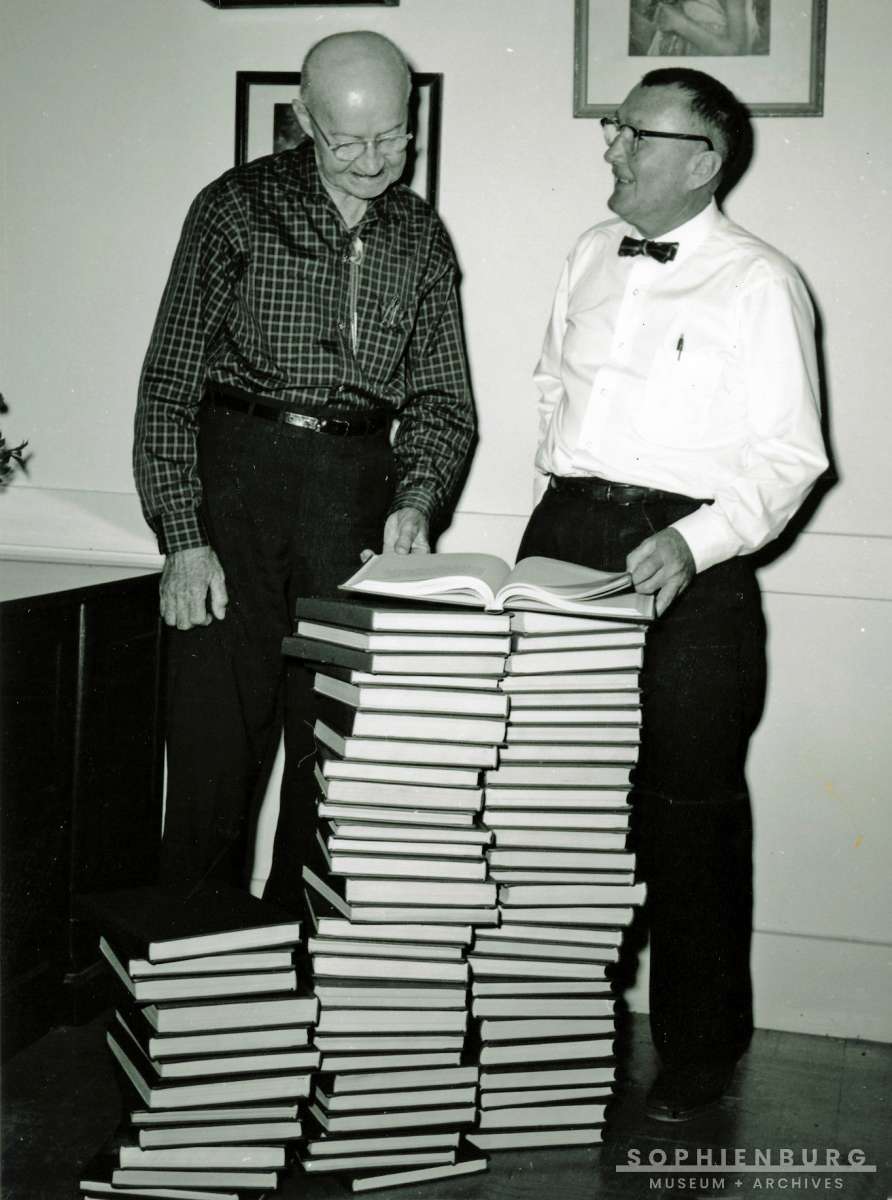
The Sophienburg has over 500 genealogies of New Braunfels and Comal County names. These are bound volumes of family genealogy that were generated by museum personnel and family members before Ancestry, Family Search and other databases. These volumes contain wonderful anecdotal information which is really what makes your ancestors come alive.
Along with the family histories, the Sophienburg Archives has an almost complete collection of the German-language newspaper Neu-Braunfelser Zeitung (1852-1957), the New Braunfels Herald (1895-1957) and the New Braunfels Herald-Zeitung (1957 to present day). These are all on microfilm and can be referenced at the Sophienburg by appointment.
The German Zeitung was painstakingly indexed by volunteers prior to 2000. It can be searched by name or by subject. Of course, the articles will be in German. But that’s okay, because some of us can still read German and, if necessary, you can Google translate it. Newspaper articles will include birth, marriage and death information, as well as everyday occurrences in local, state, national and world news. We are unique in having an overlap in two languages — news is reported with different perspectives. The New Braunfels Herald and the Herald- Zeitung can also be accessed online at the New Braunfels Public Library’s digital newspaper archive.
The Sophienburg Photograph Collection has over half a million images of New Braunfels and the surrounding area. These images (prints, negatives and slides) span the history of New Braunfels and Comal County from the early 1860s to present day. The Photograph Collection illustrates people, homes, city streets, businesses, and farms. It immortalizes city and cultural events and celebrations like parades, festivals and weddings. The collection includes most of the negatives of the Seidel/Braunfels Studio which photographed city and citizens from the 1920s thru the 1970s. The collection is widely used by people searching for old family members, authors needing illustrations, homeowners wanting views of their property and businesses looking for images of New Braunfels in the old days. Copies can be purchased for use and display.
The Sophienburg’s Archive Collection includes early hand-drawn maps and later printed maps of the city, certain neighborhoods, and the county. We have several Sanborn Fire Insurance maps which wonderfully show the evolution of buildings and homes as they rise, are renovated and then replaced. These are my favorite because they include details of building construction, materials and even where the outhouses and wells were located. Other maps in the collection show topographical information which, when it rains again, will show why your street tends to flood after an inch or two.
The Sophienburg welcomes you to come and research in our spacious reading room. There will always be a friendly staff member available to help you find what you are looking for. Well, you might not find ALL you want to know. Research, like detective work, seldom finds all the answers to all our questions. However, it is really fun to try!
To do research, please contact The Sophienburg at 830-629-1572 during office hours (Tuesday–Saturday, 9 a.m,–4 p.m.) to make an appointment. Daily fee for the Archives is $25 and includes our helpful personnel and admission to the Exhibit Floor. If you need more time, your fee can easily be rolled into an individual membership that allows you unlimited entry to the archives for just $50 per year.
See you in the stacks!
“Around the Sophienburg” is published every other weekend in the New Braunfels Herald-Zeitung.