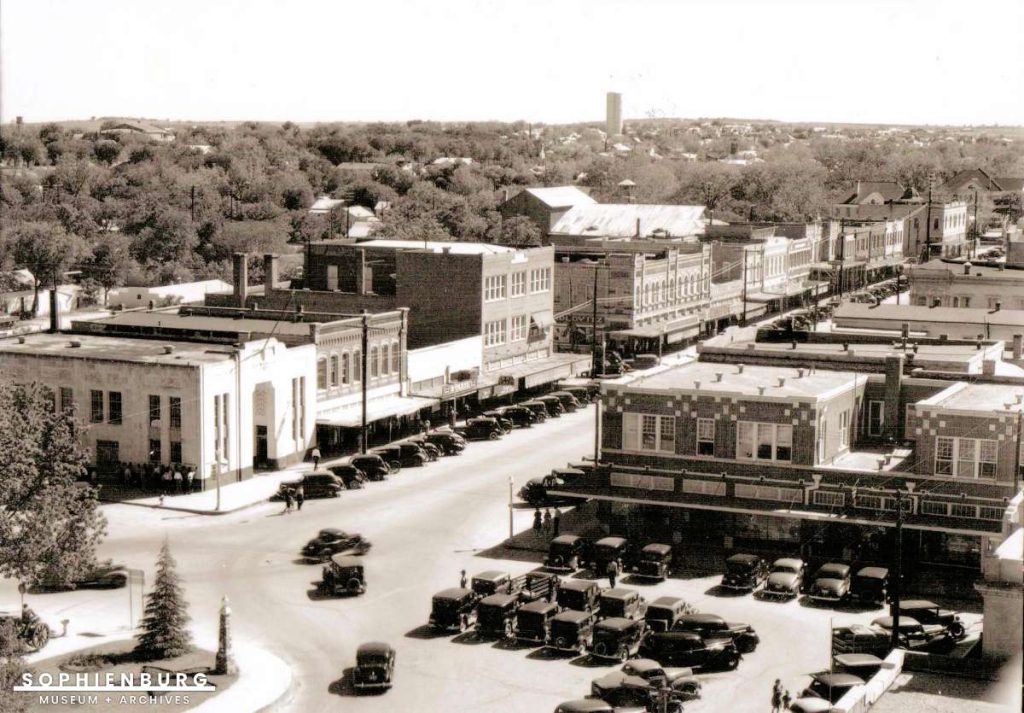
By Keva Hoffmann Boardman —
What if New Braunfels was not named New Braunfels? I had never considered this, but of course the wonderful historian Oscar Haas did and recorded his findings in his book, History of New Braunfels and Comal County 1844-1946.
There are two occasions on record wherein New Braunfels nearly lost its place-name. — Oscar Haas
Many of you readers know that New Braunfels was named and founded on March 21, 1845, by Prince Carl of Solms-Braunfels. He chose to name this town after his hometown of Braunfels on the Lahn River in Germany. The first time the name “New Braunfels” was in jeopardy was just prior to the creation of Comal County by the First Texas Legislature.
There was much talk of creating a new county with our town as the county seat. There was some dispute as to whether the county seat should be called New Braunfels or Comaltown. — Oscar Haas
The Republic of Texas began creating counties in 1836. Rusk County was the 36th and the last to be formed during the Republic. In March 1846, Comal County became the 44th county and was formed from the eighth precinct of Bexar County. Bexar County was the third county created by the Republic of Texas and it was beyond enormous. Between 1845 and 1876, the Texas Legislature formed over 120 new counties from what was originally Bexar County. Just FYI: there are 254 Texas counties.
New Braunfels kept its name. It is interesting to note that a lot of county seat cities are located near the center of the county so it is reasonably accessible to the whole county. New Braunfels sits on the southeast boundary of the county as it was, and still is, the largest city in Comal County.
The second time New Braunfels found its name in danger was in 1918. The October 31, 1918, edition of the Neu-Braunfelser Zeitung published an article first published in the October 29, 1918, edition of the Galveston News.
The war with Germany has set a movement on foot aimed at changing the name of the City of New Braunfels. It could be that the loyal descendants of the German colonists of the year 1845, who settled there … [would] under present circumstances consider it a disgrace. It may be true that Prince Solms-Braunfels was not possessed of great aptitude. It is said that he left the colony in the lurch at a critical moment and that his successor had to pay some of the Prince’s debts in Texas and that he never returned.However, New Braunfels is an established name that has grown estimable to the highest degree through the citizenship of that community among whom are many direct descendants of the colonists who landed at Galveston and via Indianola came overland to the Comal in search of freedom and opportunity. The name signifies a great deal with regards to history and cannot possibly have any bearing on the present international state of affairs.
With the place-name New Braunfels, which stems from an ancient place-name of the old country, with its street names, Texas possesses an aesthetic treasure. In New Braunfels one finds Spanish, Mexican, Indian, German, and unalloyed Texan street names, in a manner that reveals beauty and meaning. The picturesque historical names of Texas cities, which came into existence since the Republic, are Texan. Names should never be changed just because of a foreign country origin whose behavior we do not sanction.
To the above article, the editor of the Neu-Braunfelser Zeitung added:
The Galveston News has eminently reasonable views in such matters. Besides, here, no one thinks of changing the name of our city, which, moreover, is not named for a prince, but an especially pretty little city which has furnished our country with admirable citizens. Loyalty is not proven by name-changing or through vandalistic destruction of historical characteristics, but through disposition and performance, and on these standards New Braunfels can confidently be surveyed.
New Braunfels has kept her name. People get it wrong, but locals will always proudly correct them to its true pronunciation.
Just for grins, Oscar Haas listed a few of the before-mentioned multi-cultural street names in early New Braunfels:
- Hispanic — Guadalupe, Nacogdoches, San Antonio, Seguin, Veramendi
- Native American — Waco (Caddo), Comal (Nahuatl), Comanche (Ute)
- German — Baden, Basel, Becker, Castell, Clemens, Coll, Dittlinger, Eickel, Faust, Giesecke, Gruene, Guenther, Hampe, Jahn, Karbach, Klingemann, Kuehler, Lindheimer, Meusebach, Seele, Tolle, Zink
- Scottish — Ferguson, Murchison
- Irish — McGaugh, McKenna
- English — Torrey, Lincoln, Water, Mill, Bridge
What multi-cultural street names can you add to the list?
And, if you are interested in more fun, unusual and “make-you-look-clever” historical facts, Oscar Haas’s book can be purchased at Sophie’s Shop in the Sophienburg Museum for $40 plus tax.
Sources: History of New Braunfels and Comal County 1844-1946, Oscar Haas; Handbook of Texas.
“Around the Sophienburg” is published every other weekend in the New Braunfels Herald-Zeitung.