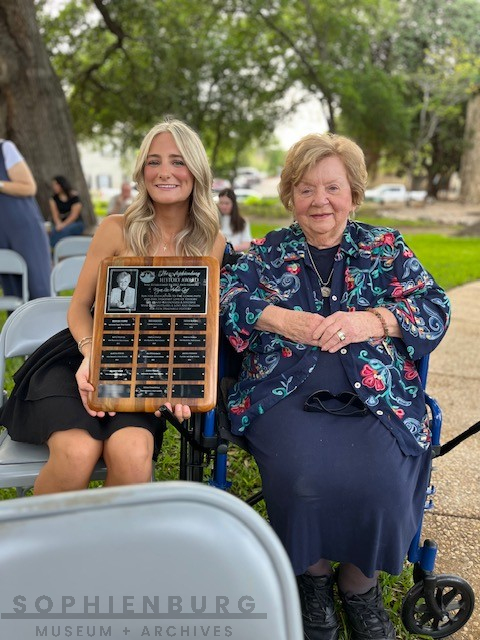
2026 Myra Lee Adams Goff Scholarship Award Essay – by Jaelynn Davidson
The Texas Hill Country was a stunning and dangerous arena of cultural conflict in the mid-19th century. To the Texas nobility of the Adelsverein, it was a fantasy of a “New Germany”; to the German peasants who arrived on the shores of the Texas coast, it was a last hope of a new life; but to the Penateka Comanche, it was the Comanchería, their ancestral domain. Although Prince Carl of Solms-Braunfels is said to have founded New Braunfels, it was his successor, John O. Meusebach, whose brilliance of diplomacy ensured that Comal County would not only survive, but flourish. The Meusebach-Comanche Treaty of 1847 was the single most important event in the early history of the county, an extraordinary occasion of mutual respect and unbroken peace in the American frontier.
Upon John O. Meusebach’s arrival in New Braunfels in 1845 to assume the position of Commissioner General, he found a colony on the brink of disaster. The colony’s finances were in shambles, and the people were dying from disease and starvation. More urgently, the land grants that the settlers received were located far within Comanche territory, well north of the Comal Springs. Although the zeitgeist of the time was one of military conquest and displacement of Native Americans, the intellectual pragmatism of a scholar and bureaucrat like Meusebach dictated that if New Braunfels was to survive, it could not be an island of Europeans at war with their neighbors.
Meusebach went on an expedition with only twenty men as an entourage to the very heart of the San Saba hills. This was viewed as a suicide mission by most. However, Meusebach knew something that his contemporaries did not: the importance of “The Word.” He was determined to meet the Comanche chiefs, namely Buffalo Hump, Santa Anna, and Old Owl, without the Texas Rangers and the U.S. Army. This was a level of respect for the Comanche that was unheard of at the time.
The treaty that came out of this was revolutionary. It was not a treaty of surrender, but of co-existence. The Germans agreed to share their land and their resources, and in return, the Comanche agreed to allow the settlers to farm and travel through the area. Perhaps most importantly, the treaty allowed the Comanche access into the town of New Braunfels to trade. This brought a unique cultural exchange to Comal County, where Comanche men were often seen in the town plaza trading skins for German goods. This would have been unthinkable in other parts of Texas.
The importance of this occurrence cannot be overstated with regards to Comal County. While other frontier settlements were marred by decades of “Indian Wars,” New Braunfels was spared the bloodshed that defined the Texas borderlands. This gave them the space needed to concentrate on the development of the infrastructure that defines the county today: the mills along the Comal River, the Sophienburg, and the educational system. The treaty gave the area the literal and figurative “breathing room” that was needed for the German culture to take hold and thrive without being strangled by the specter of violence.
Today, the legacy of Meusebach’s diplomacy is incorporated into the very fabric of the identity of Comal County. It is a reminder that the history of the county is not simply one of European settlement, but of American adaptation. As Myra Lee Adams Goff so often said in her historical writings, the history of Comal County is the history of “grit.” It took grit to cross the Atlantic, but it took a different kind of courage – the courage of diplomacy – to walk unarmed into the hills to shake hands with a supposed enemy.
In sum, while the physical features of the New Braunfels heritage site – The Gruene Water Tower, the Faust Bridge, and the Comal Springs – are integral to our heritage, it is the Meusebach-Comanche Treaty that is the unseen foundation upon which all of these rest. John O. Meusebach’s decision to reject the status quo of violence in the 19th– century frontier in favor of a more peaceful approach has made Comal County a shining example of industry and culture. It is a testament to the fact that peace is not merely the absence of war but a function of respectful and courageous negotiation.
“Around the Sophienburg” is published every other weekend in the New Braunfels Herald-Zeitung.