By Simon V. Simek —
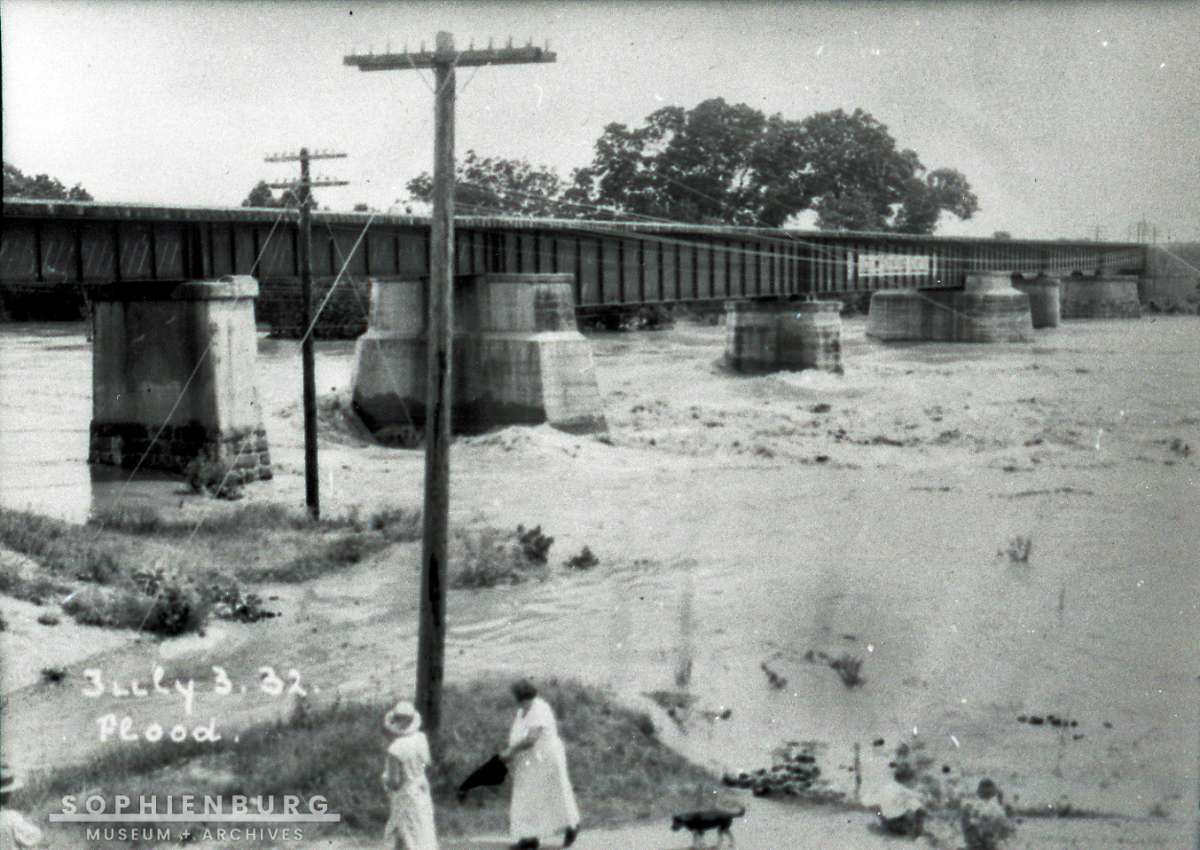
Considering the rainy days we had last week after such a long dry spell, we thought it relevant to help tell the history of New Braunfels’ eternally erratic weather, and our long-standing feud with rushing water. Diving into the archives, we found some tremendous accounts of how our predecessors fared in their own times against the elements.
The drought of the 1950s is one of the worst, if not the worst, recorded in New Braunfels history. New Braunfels was still largely agricultural, and without modern water solutions, local farmers and ranchers struggled to yield crops and raise livestock. Caroline Stange sat down in 1982 as part of our ongoing Reflections program, a local ongoing oral history effort from the Sophienburg since 1976, to tell her story and detail her experience of the ‘50s drought and the flood of 1972.
Mrs. Stange moved here a little later in life, when she finally agreed to follow her soldier son who was stationed nearby in 1955. At first, she found New Braunfels to be exceptionally clean and friendly, but also incredibly dry and hot, even in January. She had come from California, where the flowers bloomed and the weather was fair, and Texas seemed like an arid land devoid of her beloved flowers. Day after day it was dry, and her ranching neighbors had taken jobs in town to make ends meet. She regretted her move and prayed that it would rain for just five minutes. Even Landa Park and Comal Springs dried up. Finally, in 1957, the rains came, in the form of a flood, but nonetheless Mrs. Stange was thrilled to see flowers and green.
1957 was not the only flood that Mrs. Stange experienced in her adopted home. She remembered vividly the 1972 flood that happened just a decade prior to the recording. It began with a 2:00 AM call from her neighbor, who fought the loud drops on her tin roof for attention. The neighbor had heard the police come by and order residents to evacuate their homes, a warning Mrs. Stange didn’t hear. They wondered where to go, maybe to her son’s home in McQueeney, but they believed it too far. This was for the best, as that day his home would get 18 inches of water inside of it. They tuned in to the radio to hear Herb Skoog notify them that shelter was available at the civic center. The electricity had gone out in the neighborhood, but they were able to navigate their way to the lights at the civic center. While there, they saw the damage that the flood had already caused, like the mother who had her baby swept from her arms and the elderly woman wrapped in blankets who had just stood on her kitchen sink in neck-high waters to be rescued through the kitchen window. They stayed the night and returned home the next day to find Camp Warnecke’s tea towels littered about in the trees. News would stream in the next few days of others who were lost, some of them friends and neighbors. Mrs. Stange’s home was undamaged, but the flood had already wrecked its havoc on her life.
Caroline Stange and her story help visualize the seeming cycle of floods and droughts that our piece of Texas endures constantly. The Torrey mills experienced a form of this cycle as well in the previous century, although the determination to defy nature is a little more surprising.
For whatever reason, fire, air, and finally water all plotted against the earth and stone of John Torrey’s riverside plot at the juncture of Comal Creek and Comal River. Today, this is the tube chute, but it was the Torrey family who built the first dam for power. John Torrey and his brothers hailed from up North but came to Texas as entrepreneurs who sold merchandise to incoming Texas settlers. Following their success, John Torrey acquired the doomed plot of nearly two acres in 1848. He built a gristmill (grain) and sawmill, and later added a factory that made goods for the home like doors and blinds. On November 14, 1861, the first disaster struck and the entire complex burned down.
He quickly replaced these losses with a four-story stone building. Soon after, machines for cotton spinning and looms were added to the top floor. This became the first cotton factory in Texas, and it began production in 1865. In 1869, a warning came, and a flood damaged the building and some machinery, but production could continue. Just two months later, a tornado ripped through town, and the Torrey mill’s top floor was destroyed along with all the machinery.
Rebuilding was underway for three years, and in 1872, just weeks before operations could resume, the mill was struck for the last time. The summer torrent came, as it so often does, and Mrs. Trappe recalled the incident in 1945: She was only sixteen, and it had rained over 12 inches the night before, washing away the newly built iron bridge over the Comal. She watched as John Torrey and four others tried to move some of the machinery and materials from the first floor to the second. But the dam had gone, and the water pushed the building off its foundation. As it was readying for its collapse, the five men made it to the roof and looked for any escape. The only option was to grab on the telegraph wires which crossed the river. All five successfully took hold, and were able to swing towards land, jump, and ultimately save themselves. It is said that Mr. Torrey bore his losses without a murmur of despondency, but soon after he left New Braunfels for good and started again in Hood County.
New Braunfels and her residents have long been afflicted by volatile weather and overflowing riverways. That is not going to change. It is up to us, current residents of Comal County, to find the solutions, whatever those may be, to ensure our homes are here to stay for future generations.
Sources: New Braunfels Herald-Zeitung, John F. Torrey and Brothers by Susan Morrison, Around the Sophienburg by Myra Lee Adams Goff, Reflections 287 (Caroline Stange).
“Around the Sophienburg” is published every other weekend in the New Braunfels Herald-Zeitung.