(This is a special edition of Around the Sophienburg for the 250th anniversary of the U.S. Declaration of Independence.)
By Tara V. Kohlenberg —
Today, July 4, 2026, marks 250 years since the signing of the Declaration of Independence. America’s 250th birthday. New Braunfels has celebrated America’s birthday for 170 years. The celebrations have changed over time but are no less important.
New Braunfels has a long and storied history of July Fourth celebrations, the first being held in July of 1846. Our earliest founders arrived in the Republic of Texas from Germanic regions of Europe in 1845 when the fledgling America was a mere 69 years old. Within one short year, Texas was admitted into the Union, making the citizens of New Braunfels new Americans.
The first Fourth of July celebration in New Braunfels began with a bang, literally. Two cannons on Sophienburg Hill fired off at sunrise to begin the day. The Adelsverein headquarters building on Sophienburg Hill displayed a large American flag of 28 stars. That flag raising was significant because just the year before, Prince Carl had hoisted a German flag above the Sophienburg while a group of settlers strung up the flag for the Republic of Texas on the Plaza. Three different flags flew over New Braunfels within one year.
The newly minted Americans were very patriotic and found it exciting to celebrate their nation in grand displays of music, parades and patriotic oratory (speeches). Nearly every organization had a band or choral group.
In 1866, the day began with cannon fire. The Declaration of Independence was read by a prominent citizen followed by a short address and most likely the Pledge of Allegiance in German. A festive procession of townspeople was led through the streets by the brass band of the 4th Regulars Union Cavalry Regiment followed by evening dances in several dance halls.
One of the most elaborate and dramatic Fourth of July celebrations ever held in early Texas was the one in New Braunfels saluting the U.S. Centennial in 1876. It was so extensive and elaborate that it received statewide publicity. The Texas Post, a San Antonio German newspaper, reported, “The Centennial of the Declaration of Independence of the United States of America was celebrated with dignity befitting the jubilee, greater than in any other city of the State of Texas.”
Citizens went all out for the two-day celebration, decorating their homes and businesses with patriotic flags and wreaths of cedar and mountain laurel. For the parade, they built four triumphal arches downtown close to the plaza and hung a giant picture of George Washington in the Zeitung printing shop.
Setting the tone for the next day’s events, a cannon on Sophienburg Hill was fired 13 times in commemoration of the 13 original colonies. On the Fourth, people were awakened at dawn by the rapid firing of the cannon, followed by trumpets heralding the beginning of the festivities.
The centennial parade was a historical review of the United States of America, played out in pageantry on a grand scale under the 37-star flag. The parade began with bands on decorated wagons, Columbus, George Washington on horseback, followed by floats representing Prince Carl and the founding of New Braunfels, the Liberty Bell, Lady Liberty and a myriad of floats by local organizations and industries.
The entire procession crossed the low-water bridge into Comaltown, where on a large open green (now Eagles Hall), a dance platform had been constructed along with tables and chairs. Hermann Seele gave the opening address before dancing commenced until sunup — for both days!
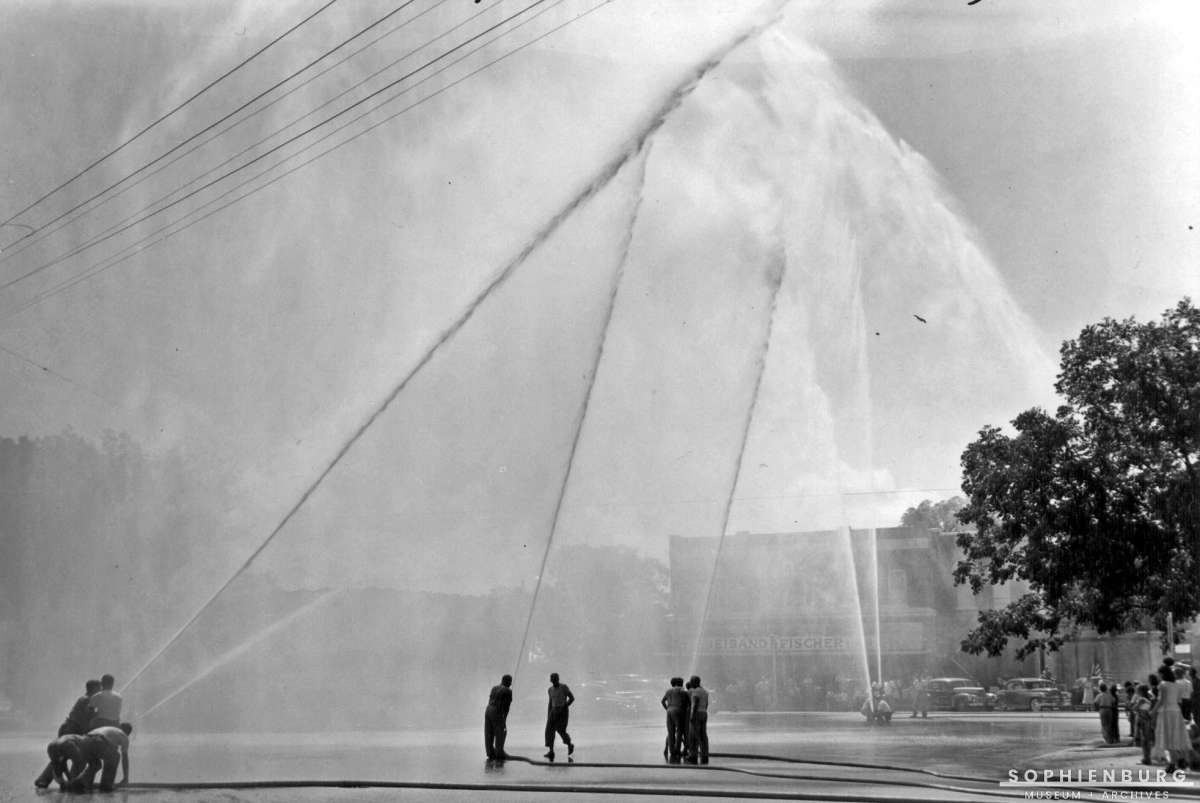
In 1886, the New Braunfels Volunteer Fire Department was formed. The volunteer department was more than a fire-fighting organization. They were one of the most active civic organizations in town, collecting toys for children and fundraising for fire equipment by putting on costumed shows (they had a band!). For more than 75 years, they were in charge of the Fourth of July festivities.
By the turn of the century, Fourth of July in New Braunfels meant not only parades and speeches but concerts on the Plaza (thus the Bandstand), foot races, baseball games, dances, and fireworks! By 1920s and ‘30s, the Volunteer Fire Department made pumper races (firemen competitions) and water displays part of the fun, shooting arches of water through the air on Main Plaza. There was also miniature golf, boating on the lake and swimming in Landa’s Park.
Many still remember the ‘60s when people gathered across the Landa Park Lake to watch the fireworks. They were set off by local firefighters trained to handle fireworks. Although there were a lot of aerial displays, a number of ground-supported fireworks displays geared to the crowd seated across the lake. Everyone knew it was the end when they saw the American flag sparkling across the water.
New Braunfels grew and changed, gearing summer holidays to more tourist trade. Fireworks displays became the work of professional companies. The volunteer fire Department disbanded as the number of paid fire personnel grew and public Fourth of July events dwindled.
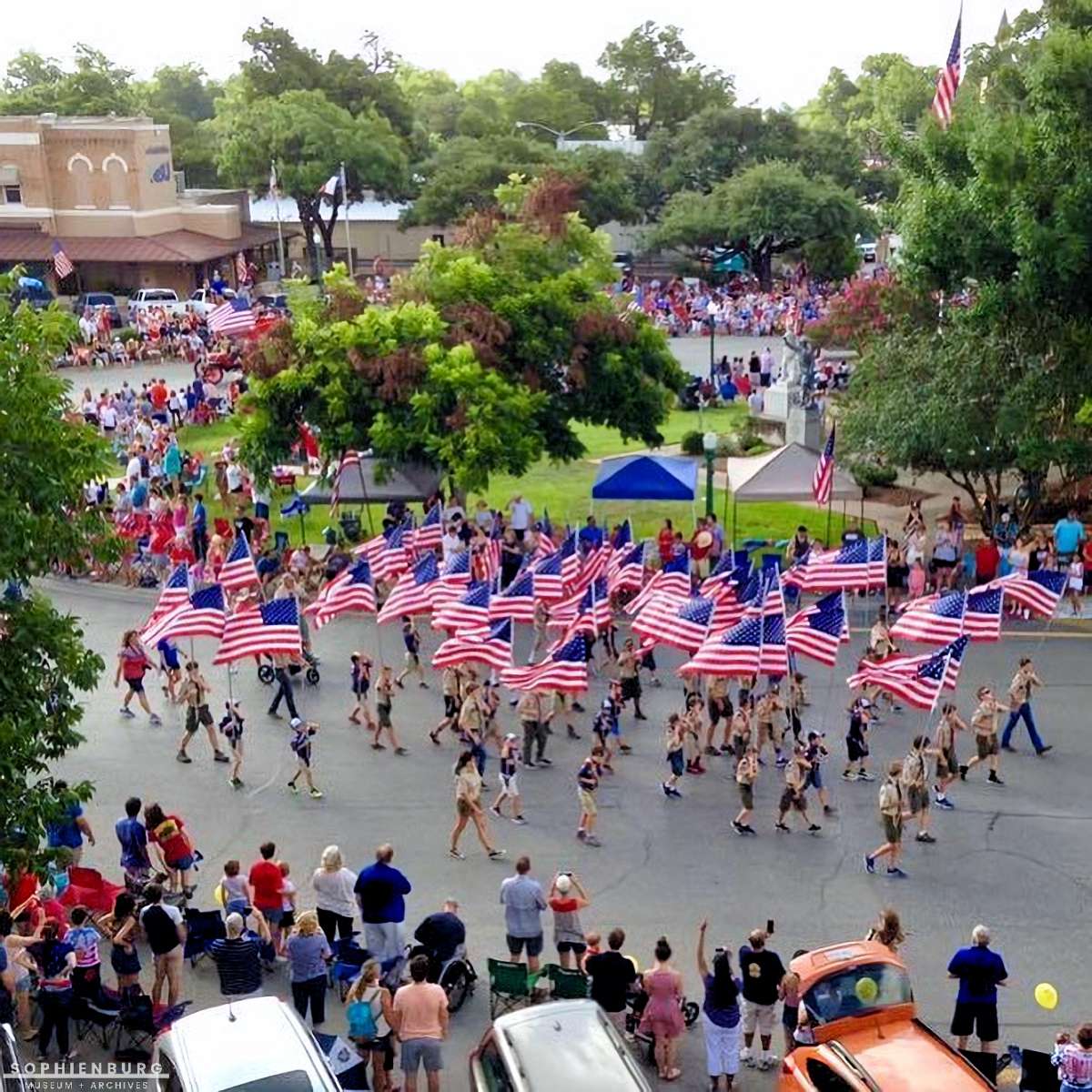
In 1978, Mayor Margaret Naegelin invited city councilmembers to her home for coffee before travelling to the plaza in antique cars, where they enjoyed ice cream and lemonade while the courthouse bells played. Mrs. Naegelin, who was also the president of the Sophienburg Museum and Archives, unknowingly initiated the first Sophienburg Ol’ Fashion Fourth of July Parade and Patriotic Program in Downtown New Braunfels. This year marks 48 years. It has grown into a collaboration with the City of New Braunfels and remains one of the oldest traditions celebrated by our Founding Fathers — of both America and New Braunfels.
Happy 250th birthday, America!
Sources: Sophienburg Museum and Archives; Oma & Opa, German Texas Pioneers by Curt E. Schmidt; Around the Sophienburg by Myra Lee Adams Goff.
“Around the Sophienburg” is published every other weekend in the New Braunfels Herald-Zeitung.