By Keva Hoffmann Boardman —
New Braunfels citizens have never been shy in expressing their opinions in print or in demonstration. No other subject was more hotly contested than the issue of prohibition.
In December 1917, the 18th Amendment – the Prohibition Amendment – was passed. It banned the manufacture, sale, or transportation of intoxicating liquor. However, the political, moral and constitutional fight over prohibition in Texas began when The Republic of Texas passed the first local-option law in 1843. This allowed towns and counties, not the Republic, to decide the issue for themselves. The ensuing years saw the slow swing from anti-prohibition to prohibition.
In 1887, prior to a statewide prohibition referendum, the local newspaper ran many articles and editorials against prohibition. The referendum failed spectacularly across the state: 220,627 votes against, 129,270 in favor. After the referendum’s defeat, Bulverde made it known that there was not one vote cast in favor of the referendum in their precinct. Clear Springs held a huge victory dance. One local establishment even refused to sell a beer to a local prohibitionist telling him to “go drink water”. In the following month, the “Victory Banner of 1858” was delivered to New Braunfels from the States Executive Committee of the Anti-prohibitionists. The banner, featuring Sam Houston and his motto “Texas and Freedom”, was given as an award for the staunch anti-prohibition feelings displayed at the polls. The banner also commended Comal for being the leading democratic county of the State.
Prohibition gained ground after the turn of the century. Texas “drys” tried to pass prohibition legislation again in 1908 and 1911.
The most colorful and “heartfelt” demonstrations Comal Countians have ever undertaken were anti-prohibition events. In October 1908, several rallies were held in the county with the largest taking place on Main Plaza. Symbolically empty beer kegs and planks performed the job of bench seating. Participants needed to be comfortable while listening to the several important and influential men speaking in German about the loss of personal liberties from prohibition laws. German speaking events were very popular and drew people from all the neighboring counties.
Then in 1909, New Braunfels made headlines across the state. Prohibitionist Texas Governor Thomas Mitchell Campbell declared war on the counties not enforcing the 1907 Baskin-McGregor Act. The act mandated that saloons in Texas be closed on Sundays and prohibited women (waitresses, bartenders or prostitutes), musical entertainment and gambling from barrooms. “Sunday closing” or “Blue laws” meant that establishments in urban areas selling alcohol had to close at midnight on Saturday and stay closed until Monday morning. For New Braunfels, the part of Baskin-McGregor that applied was the enforcement of the Sunday closing law. It was a true infringement and violation of their personal liberty; never in 63 years had local businesses been forced to “put the lid on” Sundays.
The governor issued ultimatums to towns with large German populations like Galveston, San Antonio and New Braunfels. These were followed by threats to enforce the Baskin-McGregor Act by sending in the Texas Rangers. Governor Campbell put on more pressure and considered holding back money from the County Commissioners until they agreed to comply and enforce the law. Men from Austin came to talk to the locals and local leaders went to Austin to talk. December 29th was set as the day of reckoning. With Rangers enroute, New Braunfelsers locked the doors of their drinking places at noon and participated in a very formal, very somber “Funeral for Lady Liberty and Lady Freedom”.
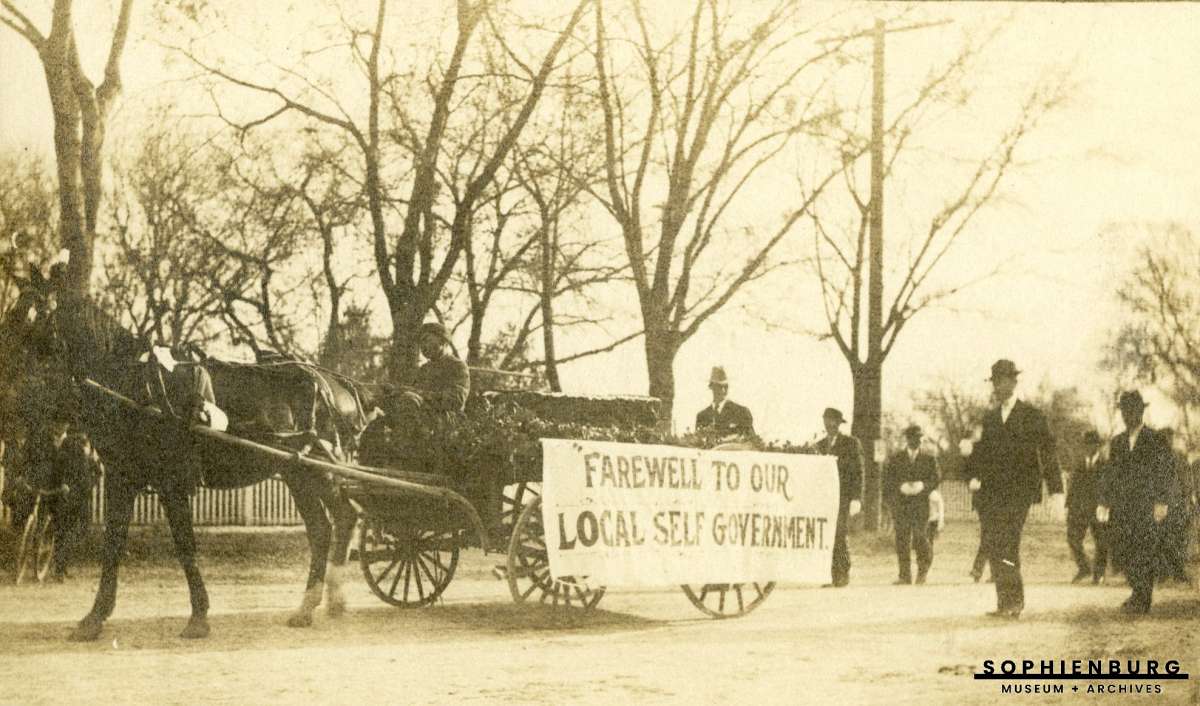
Hundreds of local men, donned in their best black suits and top hats, met on West San Antonio Street. Following the famed “Victory Banner of 1858”and the “Banner of 1887” carried by Ferdinand Paulus and Julius Wills (both famed for their acting abilities), the men walked slowly and purposefully in mourning behind a decorated caisson carrying life-size coffins fashioned from heavy paper. Inside were paper “corpses” of Liberty and Freedom. Local leaders were pallbearers. On either side of the funeral wagon were large signs flaunting the words, “We close of our own accord and not by force” and “Farewell to our local self-government”.
A 25-piece brass band followed the hearse playing a specially composed, “Baskin-McGregor Waltz”. The waltz was “pronounced by music critics to be a gem in its own way.” Straight rows of male mourners walked in stately manner behind the band. Black draped bicycles, wagons and carriages of more mourners made up the rest of the parade. Another draped wagon filled with an orchestra brought up the rear.
The funeral march made its dignified way three quarters around the Plaza. The male mourners then joined women and children already gathered around the Bandstand. The newspapers estimated that a crowd of more than a thousand attended the demonstration.
Incredible photos of the event show that a long paper banner was unrolled which was covered with a tongue-in-cheek German poem and illustrations. After the obligatory speeches and obituary, the townspeople cremated the effigies of Lady Liberty and Lady Freedom. Yes, they were burned right there on the Plaza.
You have to wonder if the Texas Rangers were standing there watching this truly remarkable example of First Amendment freedoms along with the reporters. I am certain many out-of-towners agreed with the New Braunfels citizens.
You will be able to learn more about this event in a special exhibit at the Sophienburg Museum & Archives opening this summer.
“Around the Sophienburg” is published every other weekend in the New Braunfels Herald-Zeitung.