By Keva Hoffmann Boardman —
It was a comfortable warm evening, Valentine’s Day, 1976, in fact. I was one of a group of NBHS seniors sitting on the hoods of several cars parked in front of Ortiz’s Bar across from the Brauntex. We had been told that the Freedom Train was making its way from San Antonio to Austin that night and would pass through New Braunfels, sometime around 10?
We began our vigil well enough, using up the time talking and messing around. Like I said, we were seniors and we were really excited about graduating in the U.S. Bicentennial year. The lure of the Freedom Train was that it had the Liberty Bell in one of the cars. That, and we were out with the guys.
When Saturday, February 14, became Sunday, February 15, Ortiz’s Bar was closed with the perfunctory heavy chain and padlock through the fist-size hole in the double doors. As the world around us grew ever more silent, we became ever more bored. So what do you think a bunch of guys and girls thought they could do in such a situation? You who were teenagers in the ‘70s will know. But for the rest of you reading this, we did the only sensible thing while waiting — we paired off and began “making out.”
I’ll let you guess what that entails, but it was not “hooking up.”
Eventually, the steam locomotive, with its distinctive sound and whistle, reminded us why we were by the railroad crossing on West San Antonio Street at 0-dark-thirty. Engine #610 rumbled by slowly enough for us to see into the lighted glass-sided rail car. And there it was, the Liberty Bell — and there it went. The Freedom Train continued on to Austin and beyond.
The Liberty Bell. It is one of America’s iconic emblems. We have seen it on stamps, war bond posters, bumper stickers, on souvenirs and in movies. But what do we really know about it? Here are some fun facts about our famous symbol of freedom.
- The Liberty Bell was cast in 1751 in London and hung in the Pennsylvania State House. It cracked on the first ring. It was melted down and recast by local metalworkers, John Pass and John Stowe. Remember the clue in the movie “National Treasure”?
- The Liberty Bell weighs 2,080 pounds and is 70% copper and 25% tin, with traces of lead, zinc, arsenic, gold and silver. It measures 12 feet around the lip, 7 feet 6 inches around the crown, and 3 feet from lip to crown.
- The famous words on the Liberty Bell come from the Bible (Leviticus 25:10): PROCLAIM LIBERTY THROUGHOUT ALL THE LAND UNTO ALL THE INHABITANTS THEREOF.
- In 1835, abolitionists appropriated this message and renamed the Pennsylvania State House Bell the Liberty Bell.
- The Liberty Bell’s famous crack is a subject of debate. Hanging in the Pennsylvania State House, the bell was often used. The Liberty Bell cracked in 1835, while being tolled in honor of Chief Justice John Marshall. In 1846, the Liberty Bell was repaired so it could be rung at George Washington’s birthday. When the bell was rung a new crack developed. It is this crack that we see today!
- A story was written by George Lippard in 1847 which associated the Liberty Bell with the first July 4th and it become a part of the bell’s folklore. Most agree that it was not actually rung on July 4, 1776.
- The Liberty Bell did ring to call the citizens of Philadelphia together to learn news of the Revolutionary War, and it was rung when Cornwallis surrendered to Washington and the war ended. The last time the bell was sounded was for Washington’s birthday in 1846. That was the last time people heard the bell ring freely with its clapper. Since then, “ringing” of the bell is produced by using a hammer against the exterior.
The Liberty Bell has travelled widely. It was first moved in 1777 from Philadelphia to Allentown to keep it from being melted down for cannons by the British. The bell has also made trips across the nation to spread its message of freedom: World’s Industrial and Cotton Exposition at New Orleans (1885), World’s Columbian Exposition at Chicago (1893), Cotton States and Atlantic Exposition at Atlanta (1895), Interstate and West India Exposition at Charleston (1902), Bunker Hill Celebration at Boston (1903), Louisiana Purchase Exposition at St. Louis (1904), and the Panama-Pacific Exposition at San Francisco (1915). It was during its return trip from San Franciso to Philadelphia that the Liberty Bell came to New Braunfels!
On October 8, 1915, the editor of the New Braunfels Herald noted that the Liberty Bell was going to stop at San Marcos on November 17 for a one-hour stop and that “Sunny San” intended to make a big holiday of the occasion. He indignantly asked the question, “Why not at New Braunfels?”
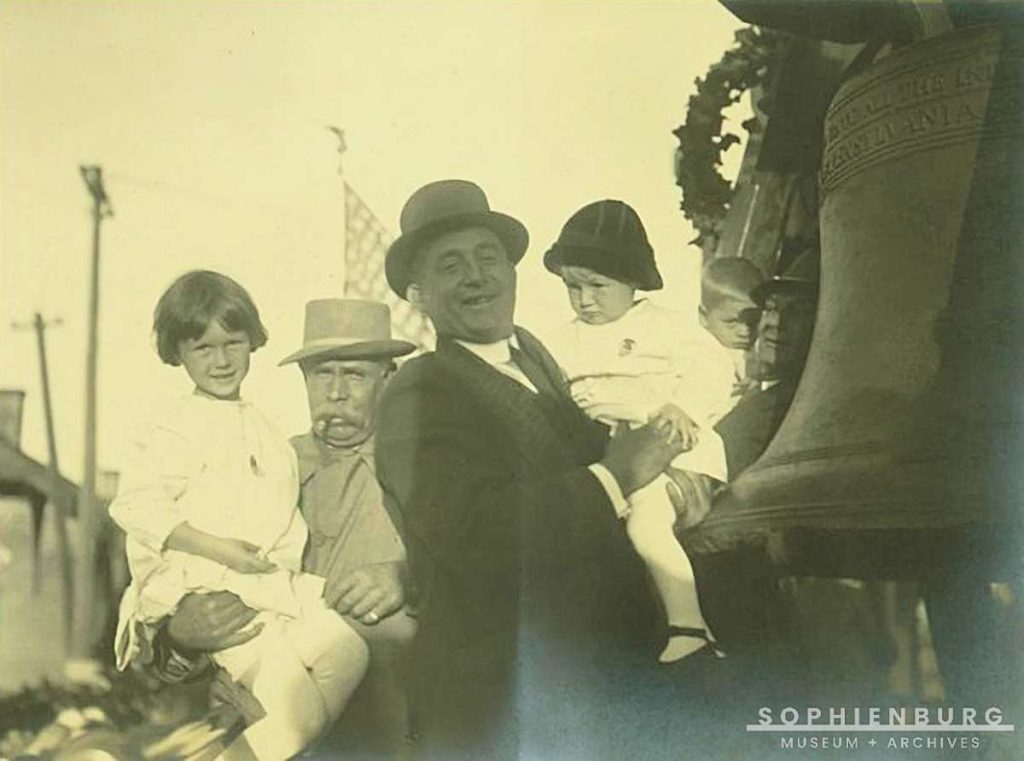
Well, someone must have gotten in touch with someone who got in touch with someone else, because it was reported in the morning release of the November 17 Neu Braunfelser-Zeitung, that the train would come through New Braunfels at 1:50 p.m. for a five-minute stop. A five-minute stop would “afford a chance for citizens to view the precious relic.” Around 2,000 people assembled at the Missouri-Kansas-Texas depot to witness the historic event. Businesses were decorated with U.S. and Texas flags and then closed at noon to allow folks to gather at the station and along the railway tracks on both sides. A local band came to play patriotic music. The New Braunfels Academy released its students. The children then collected again into a group and with little American flags in hand, prepared to sing, “My Country, ‘Tis of Thee.”
But the train didn’t come….
A little before 4 p.m., the much-delayed special locomotive was seen coming down the tracks. The townsfolk and children quickly regrouped in readiness and the band began playing. The locomotive was pulling six cars. One car accommodated the bell’s travelling committee and custodians. A special all-steel Pullman flat car, with a brass railing barrier, carried the Liberty Bell which was suspended in the center on a wooden yoke so it could be clearly seen. The children began singing their practiced song accompanied by the band. Reporters shared that “the hundreds of school children, waving as many little Stars and Stripes, made a most attractive and animating impression, hardly to be forgotten during the lifetime of those who witnessed it.”
They waited to see the Liberty Bell come through town in 1915; we waited to see the Liberty Bell come through New Braunfels in 1976. What I just learned in writing this story is that we 1976ers did not see the real Liberty Bell. What we saw was a scaled down version — well, one of many scaled down versions which traversed America on the Freedom Trains. I must admit, I’m feeling a bit depressed by this revelation.
Sources: Sophienburg Museum & Archives: Haas collection; archived newspaper collections; Texas State Historical Association; Smithsonian Magazine; America’s Freedom Trains.
“Around the Sophienburg” is published every other weekend in the New Braunfels Herald-Zeitung.