By Keva Hoffmann Boardman —
On Sunday, October 12, 1884, Texas witnessed its very first Fischerstechen right on the Comal River. Earlier in 1882, Clemens Dam had been completed and destined as a source of power for a textile mill. That same year, a benevolent society, the Knights of Honor, had been organized and one of its enterprising members, Dr. August Berger, came up with an idea to promote the mill, the association and the city of New Braunfels. The Knights of Honor would host a Fischerstechen on the Comal.
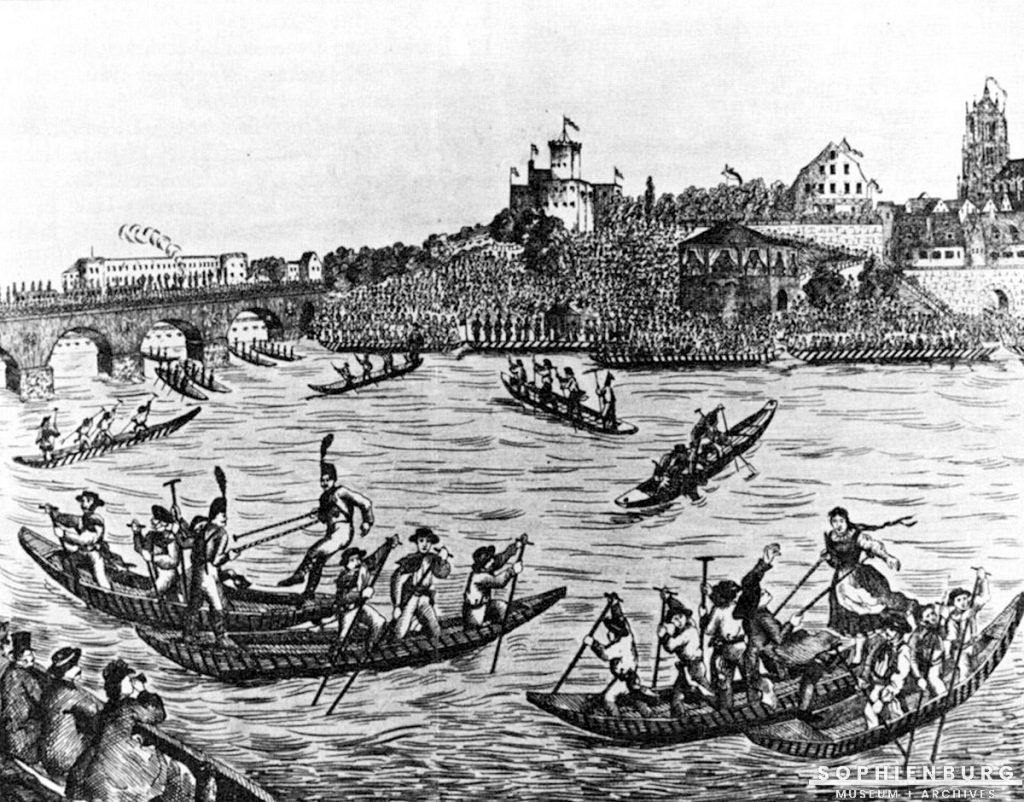
A Fischerstechen — a fishermens’ joust — was an event the Germans were familiar with since the 12th century. It was and still is in many cities in Germany and France, a festival on land and water. Parades and jousts highlight the day or weekend events. Very basically, there are boats with rowers (the horses) and combatants with padded lances (the knights) who attack each other in order to fell the opposing team’s man. Two styles exist in Europe. The first has two boats propelled by 3-10 oarsmen at high speed towards each other with the aim to go past and strike the opponent’s “knight” off the board he is balancing on. The second has smaller boats, with the “knights” standing in the front of the boat, and the 2-3 rowers manipulating for position around the opposing crew to help stabilize their man so he can knock off the other “knight.”
Obviously, balance is the key to winning. But also important is being in full Medieval regalia! The lance used is 2.8 meters long and has a padded “button” or tip. Blows can only be landed around the shoulders and chest — and yes, bruising and broken ribs are inevitable. The knight not knocked into the water wins the match. After all competition is eliminated, the winners are crowned, including a jousting king who has somehow survived each showdown without getting wet.
OK… even today this would be something to watch, but put it all the way back into 1884 on the Comal River, and you can definitely see the appeal.
The Fischerstechen in the fall of 1884 was beyond incredible. The weather had cooperated and held at a balmy 80ish degrees. First, the Comal was dammed up beneath Clemens Dam to form a large river lake that was 20 feet deep. Man-made “islands” were constructed off the riverbanks to serve as stages for singers and musicians and places for scenery changes. Dr. Berger came up with and advertised an ambitious program that included: canon fire at 2 p.m.; a parade of costumed participants through downtown; maneuvering of gondola-style boats to the river lake; dramatic living tableaus of a Venetian fisherman’s life including a wedding, baptism, dance and funeral; the Fischerstechen, fishermen jousters; children swimming; river fairies; singers and musicians. And that was just the afternoon’s events.
The evening on the banks of the river lake and its “islands” was illuminated with Bengal fire, Chinese lanterns, rockets and Roman candles. The descriptions of this fantastic spectacle filled columns of newspapers in Austin, San Antonio and New Braunfels. Of course, they are mostly in German. But what I found out in the hours of translation is that the journalists were pleased with the event and very cheeky in their assessments of the festivities.
One journalist in particular describes the day in such illustrative words that it takes three full columns in his newspaper. Julius Schuetze was the editor of the Texas Vorwartz out of Austin. He was well known by most of our early founders and good friends with most of them. His day began on a train ride from Austin to New Braunfels on which he met and chatted with Governor Ireland of Texas, who was “coming to New Braunfels on business” but ended up participating in the day. The roundtrip ticket was around $1.45 from Austin and 95 cents from San Antonio. It was advertised in the newspapers for several weeks running.
Governor Ireland was joined on the day by Seguin’s State Senator Burgess. New Braunfels had been festooned with garlands and flags. Matzdorff’s Halle (Eagle’s Hall) was a sort of meet-and-greet place for visitors and dignitaries, who after “much hand shaking” and some beer drinking, walked to the riverbank. While watching the Fischerstechen, Julius Schuetze commented that not only were the young people on the gondolas getting wet, but so were their friends and neighbors shouting from the riverbank with their own “wetness” (beer). Lone Star beer was tapped and flowing thoughout the day.
Journalist Schuetze described in vivid detail each floating tableau of the Venetian fisherman’s life. He makes a snide remark about the bishop on the wedding boat performing the wedding in Lutheran vestments. He wonders aloud how a baby could be conceived and born within thirty minutes, unless of course, it had already been conceived and born prior to the wedding (wink wink). He describes with laughter the tableau of two monks kidnapping a young maiden and then getting dunked by the ferryman and his son who save her.
The night held its own attractions. Neptune made an appearance along with Aphrodite and her nymphs as they swam in diaphanous costumes under the man-made flares and fireworks. Schuetze and Governor Ireland agreed that “the inadequate lighting made the bathing scene uninteresting.”
When the festival had run its course, New Braunfels was still in a party mood. Men and women gathered at Lentzen Hall and the Guadalupe Hotel downtown for dancing, music and glasses of beer. Company F, Woods Regiment were holding their 20-year reunion at Lentzen’s and had the governor for dinner and a speech. When the governor retired to the hotel, Capt. Bose led a brass band into the lobby to serenade him. He came out, spoke again and bought a round for all in the room. Retiring to his room once again, Governor Ireland was recalled by a group of Geronimo Farmer’s Verein members who had come to sing for him. Another speech, another glass of beer, another song — this time he went to bed and stayed there.
You would think that the day/evening had finally come to an end, but you’d be wrong. The Geronimo guys could not cross the river in the darkness to get back to Geronimo. They had to wait for the moon to rise. So, they kept singing and drinking at the hotel until a pale sliver of moon came up at about 2 a.m.
New Braunfels finally went to sleep.
Oscar Haas found this story in the Neu-Braunfels Zeitung and wrote about it in the 1960s. In 1962, there was a Comal County Championship Swim Meet at Landa Park pool to which was added “a special feature … canoe jousting contests between teams composed of Rotarians, Lions and Jaycees.” In 1967, the Alamo Canoe Club conducted canoe racing, jousting and kayak races at Landa Park lake. And in 1971, the San Antonio Canoe Club planned to hold canoe jousting on Landa Park Lake in conjunction with Wurstfest. The event was cancelled because the participants failed to show up due to some of their members being injured at the bridge in Gruene.
If you know any information about these later Fischerstechen please contact me at the Sophienburg Museum.
How many of you want to see this again!?!?
Sources: New Braunfels Herald, 1962, 1967, 1971; Neu Braunfelser Zeitung, 1884; Freie Presse, San Antonio 1882, 1884; Texas Vorwartz, Austin, 1884; Oscar Haas Collection, Sophienburg Museum & Archives.
“Around the Sophienburg” is published every other weekend in the New Braunfels Herald-Zeitung.