By Tara V. Kohlenberg —
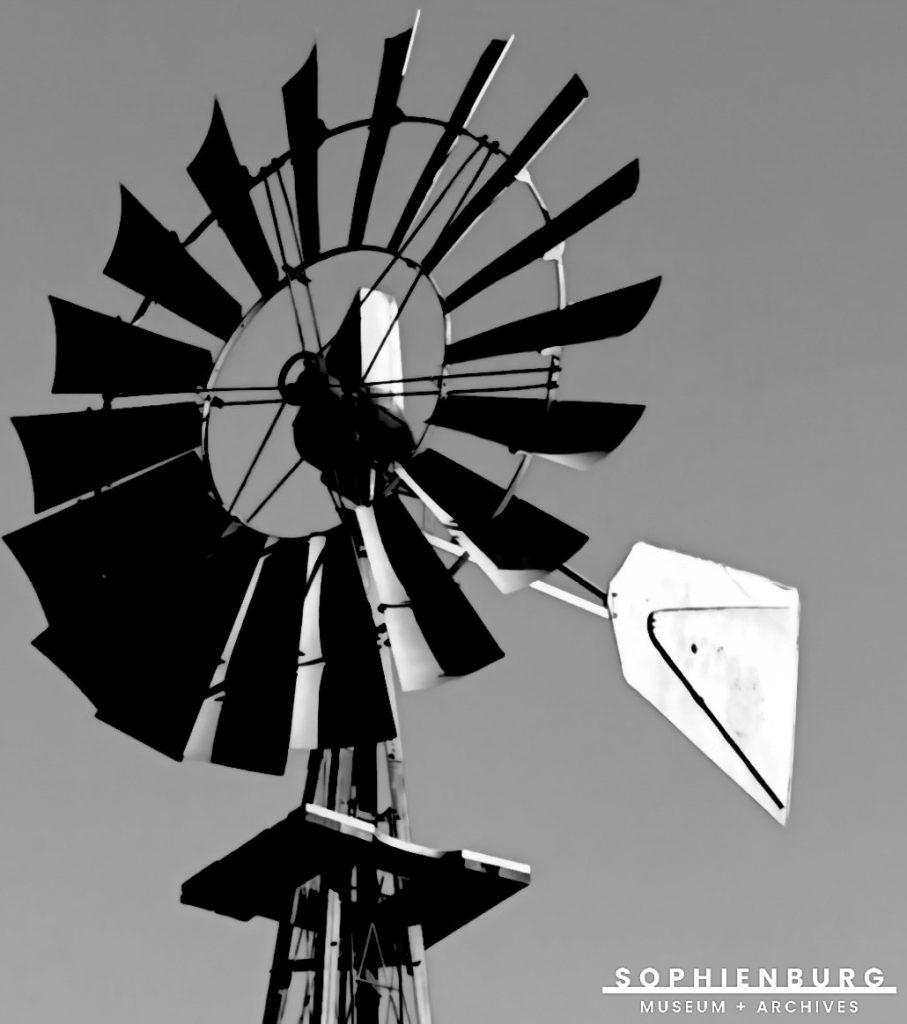
One evening last week, as I sat on the porch with a glass of sweet tea, pondering my day and hoping for rain, I heard the low metallic groan of the windmill as the head turned around to catch the wind. I saw the shadows of the windmill blades spinning on the ground before I heard the rhythmic, musical clanging of the rods going up and down in the pipes. It made me smile, to think about the thousands of windmills I have counted on long car rides through the South Plains in Texas.
It also made me sad to realize that windmills, the iconic symbols of pioneer survival across America, are fading away. A much-loved subject of artists and photographers alike is becoming a relic of the past.
My Gran, born to ranchers in the Texas Panhandle at the turn of the century, told me more than once, “Water is life. Without windmills, there would be no water in vast parts of Texas.” Windmills have allowed people to live and raise livestock in places where surface water was limited.
The first windmills, machines powered by the force of wind in sails, were used as early as 17th Century B.C. in Mesopotamia. Windmills were engineered to mill grain and pump water away from low-lying areas in Europe (think Dutch style) and around the world.
Windmills were used in North America to bring ground water to the surface. They were instrumental in settling the Great Plains (the middle third of the US from Arctic Circle to the Rio Grande), to have enough water for themselves, their crops and their livestock.
European windmills were big, expensive and very impractical. Daniel Halladay developed a new, smaller, less expensive wooden windmill and tower in 1854. By the 1870s and 1880s, there were hundreds of companies manufacturing windmills in various designs including solid wooden blades.
The first successful all-metal windmill (water pumping windmill) was designed in 1876, but metal windmills were not popular until the 1890s. Metal windmills were engineered with curved blades, allowing them to capture more wind than flat wooden blades resulting in more water with less effort.
Early water pumping windmills had open-gear boxes that required monthly oiling of the mechanical parts (can you imagine riding outposts on a ranch in summer or dead of winter?). Self-oiling mills came out in the 1920s, making life much easier. The enclosed gearbox only required cleaning and new oil about once a year. Windmill brands at that time were sold exclusively by designated dealers. Each brand came with various size blade diameter — 6 feet, 8 feet, 10 feet, 12 feet, etc. The depth of the well or the amount of water desired dictated what size fan blade was needed. Railroad windmills with giant cisterns for steam engines spanned 24 feet in diameter.
There were a number of different windmill brands in this area, like Aermotor, Fairbury, Flint & Walling, Dempster, Challenger, Baker and Sears & Roebuck beginning in 1915. Henne Hardware was a dealer for The Aermotor Company. Their fan tail carried the Aermotor name on both sides. The word “company” was abbreviated to Co. and stylized to look like a target, making it perfect for a little target practice. The great thing about Aermotor is that the same parts fit if it is 10 years old or 100 years old.
The Faust Company was a dealer for Samson windmills and the Flint & Walling brand (Star Model 12, etc.) which had a star on the tail. If you were to drive around Gruene and out old Hunter Road today, you would see several typical 8-foot and 10-foot Aermotor and Flint & Walling windmills, most of which are not working (pumping water). There are a couple of real treasures on private land. There is a Monitor in really bad shape, but still standing, and an open gear Flint and Walling over 100 years old. Then, at Conservation Plaza, there is an IDEAL windmill.
Kutscher Drilling, over the span of 100 years, have drilled, installed and maintained most of the windmills in a seven-county area. They used to service a lot of them. They estimated only about three dozen working water pumps left in Comal County and surrounding area. Compared to the technology available today, the windmill is antiquated and expensive. Electricity and solar power are much more economical. By the 1970s, only Baker, Aermotor and Dempster were building water-pump windmills.
Today, the use of windmills for more than just yard art is dwindling due to city sprawl, subdivisions (groundwater belongs to city), and the more efficient electric and solar power pumps. There are people who still restore them, but the windmills do not spin the same or sound the same if they are not pumping water.
I love our windmill. It is an Aermotor, pulled off a sulfur well nearby when we drilled our own well. The tower is 30 feet. The cypress cistern (with concrete liner) on a shorter tower was brought from the Kypfer farm in Geronimo. The windmill and both towers are stamped with the Henne Hardware name. I love how the mockingbirds perch on the highest fan blade to serenade us the morning. I love our windmill whether it is standing in a field blanketed in bluebonnets or snow. But I really love it when the windmill silhouette stands against a brilliant sunset. They may soon be relics. Enjoy them while you can.
Sources: The Sophienburg Museum and Archives; Baker, T. Lindsay. 1984. “A Field Guide to American Windmills”. Norman, Oklahoma: University of Oklahoma Press.; Mike Blanik; Danny Kutscher; Bobby Kutscher.
“Around the Sophienburg” is published every other weekend in the New Braunfels Herald-Zeitung.