By Tara V. Kohlenberg —
I am, by nature, a people watcher. Travel, whether by car, plane or train, presents some great opportunities to watch people, how they act in public and their fashion choices.
Fashion is fluid and the history of fashion is fascinating. Fashion is like a mirror, reflecting not only our culture and geographic region, but the influence of technology, economics, rebellion, political upheaval and war. It is like a snapshot of our world at any given time.
Take something as simple as stockings. Stockings have been worn for thousands of years. Roman soldiers wrapped their legs for warmth. In the 4th or 5th centuries AD, socks had split toes to be worn with sandals.
Both men and women wore stockings in the Middle Ages. Poor people wore stockings hand knitted of wool or linen. There was no elastic yet, so stockings were tied in place.
Stockings were elevated to ‘status symbols’ for the upper classes by the 14th and 15th centuries. Wealthy women began wearing silk stockings in the 16th century, while the poor still made do with wool or linen. In 1589, William Lee invented a knitting machine, which made stockings cheaper.
By early 19th century, stockings of cotton and wool could be mass-produced much cheaper than before. The big announcement of the 20th century was the invention of elastic which could be used in multiple applications.
Rayon filaments entered the picture in the early 20th century. Nylon was introduced in 1937, with the first nylons produced in 1939, but World War II made it difficult to get. Even though nylons could be knitted faster, stockings still had to be sewn together.
My mother was in school in the ‘40s. Stockings were not always available. She and other women used a neutral “pancake” makeup on their legs and then drew a line up the back of the legs with brown eye-brow pencil to imitate the seam of nylon stockings.
The invention of pantyhose in 1959 was a gamechanger! Up until then, women had to wear a girdle (ugh) or garter belt to hold up their stockings and it was not a fun experience. “And this relates to New Braunfels history how?”, you are asking.
I heard about Airmaid Hosiery from my mother-in-law. She worked there as a very young woman. I had no idea where it was or anything about it, so, I finally looked.
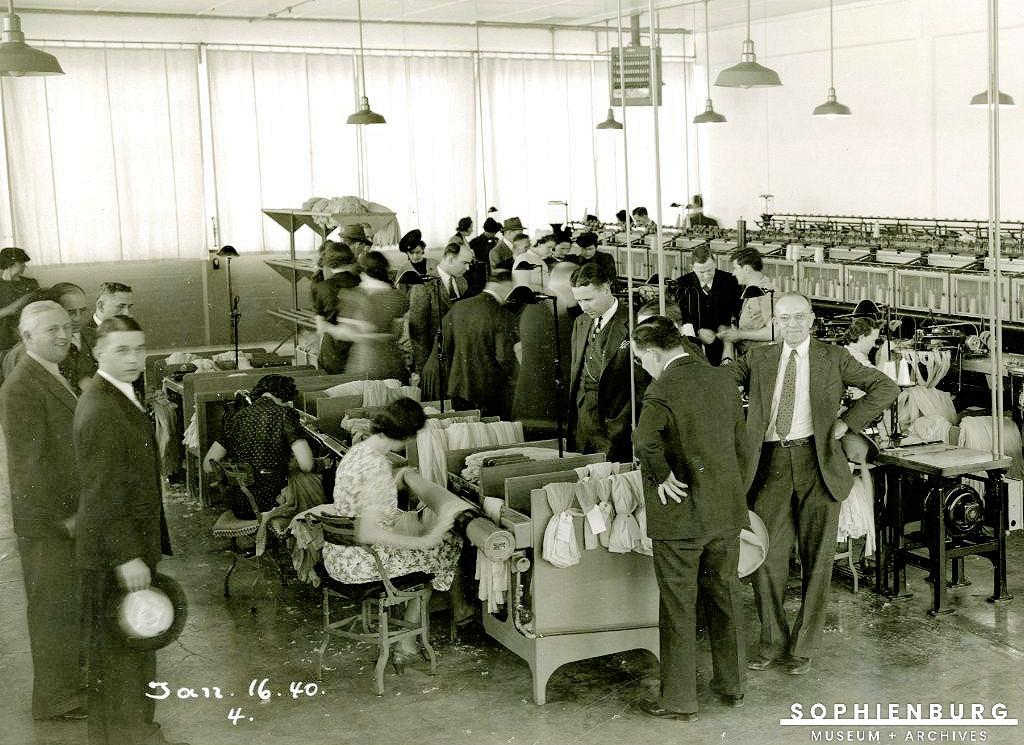
Airmaid, was a hosiery manufacturer in New Braunfels founded in 1947. They became well known for selling only to high end drug stores. The plant, located south of New Braunfels on N. West End Street, was originally owned by Texas Hosiery, founded in 1920. The plant was acquired by C. C. McGaugh in 1931, founding McGaugh Hosiery Mills. After a couple of reorganizations between 1931 and 1943, Airmaid was organized in 1947 … all boring facts until you knit the details together.
World War I ended in 1919. The U.S. Economy was getting back on its feet in 1920. Then the Crash happened in 1929 and Great Depression followed, but McGaugh bought a business. It proved to be a terrible time.
Then, World War II happened. Everything went to the war effort. Skirts got shorter, requiring more stockings to cover more exposed area leg area, but the silk supply from Japan was cut off.
Thank goodness for the discovery of nylon in ’37, but then nylon was diverted for the war effort to make glider tow ropes, aircraft fuel tanks, flak jackets, mosquito netting, hammocks and parachutes. The war effort took nylon stockings, and women learned to shave their legs in order to maintain the smooth appearance with makeup.
After the war, everything began to bounce back. Airmaid expanded the plant and moved the Dallas office to New Braunfels in 1955.
They were praised for their progressive business leadership in 1959. They boasted a modern plant with huge knitting machines weighing 16,000 pounds each and more than 160 employees. They had humidity-controlled knitting rooms, steaming rooms, dye rooms and inspection station.
The invention of pantyhose in various designs and colors in 1959 was great timing for the socially rebellious mini skirts in the 60s. Airmaid continued to sell to drug stores.
By 1964, Airmaid had a reduction in force and later closed. The plant was purchased by Bernard Altmann for McGreger Donegan Sportswear, which stayed open for a couple of years before closing permanently. The plant property has been redone. It is now the site of Win-Con Inc. Commercial Building Envelope Contractor.
Oh, and as an aside: In the fallout of all of the reoranizations of McGaugh Hosiery Mills that led to the formation of Airmaid Hosiery in 1947, M. L. Dengler left and formed Comette Hosiery Mill across town, which was in operation until the mid-70s.
Now you know a little history of fashion, stockings, Airmaid, and world history/economics.
Sources: Sophienburg Museum and Archives; History of Costume by Blanche Payne
“Around the Sophienburg” is published every other weekend in the New Braunfels Herald-Zeitung.