By Keva Hoffmann Boardman —
Let me tell you the story of First Founder Joseph Wersdoerfer. He came to Texas with the Adelsverein on board the brig Ferdinand in 1844. He travelled from Hahn, Nassau, with his wife, Anna nee Schmidt and two children. Joseph received Town Lot #8 on West San Antonio Street just half a block between Castell and Hill Street. Joseph also got a ten-acre lot south of town in the Live Oak Street area. He added a neighboring lot to his holdings. Three sons were added to the little family in 1846, 1849 and 1851.
And then life changed for the family.
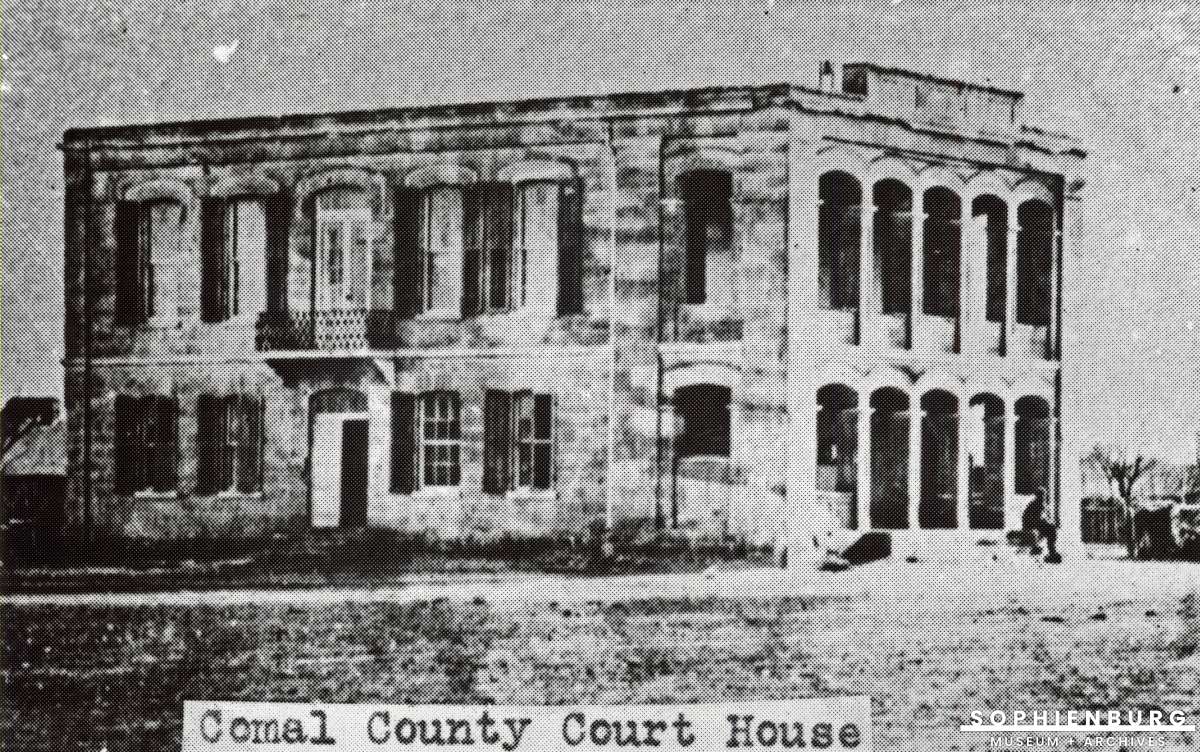
In June of 1851, Joseph Wersdoerfer was shot through the window of the Comal County Courthouse where he was being held for shooting Mrs. Wilhelm Klinger in the face with a shotgun. It was said that “citizens dragged him out of town on a cowhide.”
That’s quite descriptive … and telling.
I need to backtrack for you. I found a news article from the Colorado Tribune out of Matagorda, Texas, for July 7, 1851. I couldn’t find anything in the Neu-Braunfelser Zeitung because Ferdinand Lindheimer did not start publishing the newspaper until November 12, 1852. I will let you enjoy the lovely editorial nature of the Colorado Tribune’s story in its entirety.
A Man shot dead in the Court-House
New Braunfels, June 7, 1851
To the Editor of the Western Texian:
Dear Sir — An incident of rather a singularly serious character took place here on the evening of the 3rd. A German of the name Wersdoerfer, well known in this and the surrounding counties as an old offender, was shot dead while bound in irons, and in confinement in our Court house. As customary, this Wersdoerfer was conspicuous in the suits tried at our last District Court, and more particularly in a suit brought against him by the State for stealing horses on the Cibolo, the property of Mr. Perryman.
His guilt seems to have been clearly proved, but from reasons not easily to be defined, two of the jurors disapproved of awarding any punishment. The consequence was, that the old offender, depredator and thief, was allowed once more to prowl at large, to the infinite danger of the community and the indignation of every well-meaning citizen. The common brag of this notorious delinquent, at each offense, was that he had still plenty of gold pieces, (accumulated by his dishonest practices) wherewith to win over the exertions in his behalf of some pettifogging and pitiful lawyer, who would think low enough of himself to accept, thereby showing little respect to himself or the community in which he may reside.
As was to have been foreseen by every thinking mind, from the unpunished catalogue of crimes which this man has committed, his offences would not stop here. He made an attack for some trifling cause, upon an unprotected woman, in the absence of her husband, with a pistol loaded with cut-lead, and discharged the contents, which took effect in the head and upper part of the body. This done, he absconded. This took place on the 2nd, about a mile from town. His own dwelling is about twelve miles distant, in the Santa Clara settlement.
On a report of this cowardly and unprovoked act having reached this place, a general state of excitement ensued, and energetic steps were taken for his capture. With this intent, the officers, with a few citizens, went in search of him and succeeded in bringing him back the evening after the deed was committed. The first stopping place on arriving was the smith’s shop, where he was secured in the most effective manner.
He was then conveyed to the Court house, and there fastened, with a guard of six men around him. The community waxed in excitement, and each mind was absorbed in recapitulating the many crimes of which he had been guilty, and the manner he had escaped all. The want of a jail, & etc., presented obstacles to keeping him in custody until the next term of the Court. No fixed plan seems to have been adopted, but the determined feeling to keep him fast was unanimous.
The streets were noisy with the discussion of this subject until a late hour, when the above mentioned act of the prisoner being shot dead through the window from without, in the immediate presence of his guard, caused some reaction on the subject.
Wow. I get the outcome; he seemed to mock the whole town about his ability to buy his way out of difficulty. He genuinely did not seem to be a very good man which makes me sad for his little family that travelled all the way to Texas for “a better life”. Was he already running from the law in Nassau and just continued his life of crime in Texas?
There is a suggestion in the family history that he shot Mrs. Klinger because she asked him about a piece of land he had said he was going to sell her and then didn’t — but to shoot her in the face for that question? I can understand how people were incensed at the unjustice of it all. As always in these stories, the vigilante who dispensed justice was never identified by the community — out loud.
I found the reference for the story of his body being dragged out of town on a cowhide; it is recorded in Greek letters, not German, in the record books of First Protestant Church. It also has the Latin words Latro & Homicida (robber and murderer) with Joseph Wersdoerfer’s name, followed by words of Psalm 130. Verses 3 and 4 are poignant: “If thou, LORD, shouldest mark iniquities, O LORD, who shall stand? But there is forgiveness with thee.” That says a lot. Wersdoerfer’s cumulative record of crime was not condoned, but mercy was shown towards the man and his family. I cannot find where or if he was buried.
Poor Mrs. Wersdoerfer. She rose above this family catastrophe and remarried. She had more children and got on with life. They made them tougher back then.
Sources: Sophienburg Museum & Archives: Wersdoerfer Family Genealogy; New Braunfels: The First Founders, Everrett Fey, 1995; The Colorado Tribune, Monday, July 7, 1851; Eternity at the End of a Rope: Executions, Lynchings and Vigilante Justice in Texas, 1819-1923, Caldwell and DeLord, 2016.
“Around the Sophienburg” is published every other weekend in the New Braunfels Herald-Zeitung.